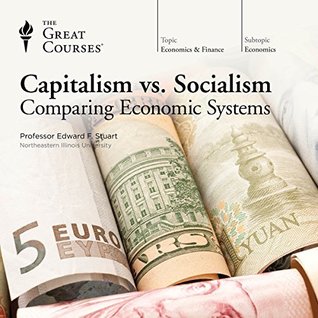
The Great Courses - Capitalism vs. Socialism: Comparing Economic Systems - Edward F. Stuart
Language: EnglishKeywords:
Capitalism
Economy
Socialism
ttc
Shared by:ihophats
Written by
Read by Edward F. Stuart
Format: MP3
Bitrate: 80 Kbps
Unabridged
Capitalism and socialism turn on the major societal issues of education, healthcare, social services, and taxation. And they raise civil liberties tradeoffs that weigh individual freedom against the social safety net and collective security. Because economics focuses on these pocketbook issues, many people believe the field is simply about money when, in reality, money is merely a means to an end. Economics is really about people and their lives, and societies have been in pursuit of the ideal system for centuries, one that can balance these ongoing, competing desires for freedom versus security. No one has found perfect equilibrium—the debates rage on and economies are in constant flux—but some major contenders have emerged, all of which are variations of capitalism and socialism in differing degrees and combinations. Determining which, if any, is the best possible option in a definitive way, however, is a Sisyphean task and one riddled with complications.
Understanding and endeavoring to solve these perpetual dilemmas is the job of comparative economics. By looking at the many economies around the world—their histories, their failures and successes—comparative economics attempts to uncover the influences, systems, and decisions that can do the most good for the most people. Guiding you through this complex web of values and theories is Edward F. Stuart, Professor Emeritus of Economics at Northeastern Illinois University, who is a specialist in both comparative economics and Russian and Eastern European studies. Professor Stuart has been traveling, teaching, and learning about these economic systems—in the former Soviet Union, the former Eastern Bloc, China, Scandinavia, and Europe—for more than 30 years. It could even be argued that he was born to be a comparative economist, raised in a household defined by the very debates he analyzes as personified in the libertarian views of his father and his mother’s social progressivism. This familial link to his subject offers a personal dimension to his approach, one that demonstrates his ongoing passion for the ways these debates play out on a global scale.
Economists venture to understand immensely complex systems that encompass not only finance and trade, but social structures, governments, family arrangements, geography, and more. The illuminating 24 lectures of Capitalism vs. Socialism: Comparing Economic Systems will show you the many ways the most influential modern economic theories were developed, how they function (or don’t), and how they manage to operate both together and in opposition to each other, from the rise of Soviet communism to the future of the European Union and beyond. As you compare and contrast the many ways societies tackle economic issues, Professor Stuart demonstrates that even the most controversial economic decisions boil down to a deceptively simple question: What makes a good society?
Measuring Success
One of the first misconceptions Professor Stuart clarifies is that there is no definitive way to determine if an economy is objectively “good” or “bad.” Rather, there are many statistics and data points economists can use to measure the relative health of a given system. From gross domestic product (GDP) to unemployment rates to inflation and even life expectancy, there is no shortage of measuring tools. The greatest difficulty lies not just in translating complex metrics, but in choosing which of these measurements matter. While discussion of GDP is common in the news, not everyone holds it as the absolute yardstick for economic success. And while few people would argue that low unemployment and low rates of inflation are good things for an economy, even fewer can agree as to whether either is a significant statistic to measure prosperity. As Professor Stuart notes, “people can argue forever using whatever statistics prove their point.”
If there are no foolproof conclusions to draw from the wealth of information available, how do we know when an economy “works”? What is more important, economic equality or rapid growth? Low inflation or infant mortality rates? As you progress through the history of capitalism, socialism, communism, and mixed-economies—and look at their manifestations across the world today—Professor Stuart will demonstrate that absolutes in economics are much like those in culture or politics: impossible and ultimately unhelpful. Rather, it is in finding balance, making comparisons and compromises, that economies discover how to prosper, stagnate, or, in some cases, collapse.
The Paradoxes of Prosperity
On the surface, the study of economics can seem like purely a numbers game, relying as it does on large-scale, impersonal statistics to focus attention on broad trends. This “big picture” approach can sometimes mean that the human costs of prosperity can be dismissed as simply the cost of doing business. Slavery and exploitation. Unsafe working conditions. Child labor. Government oppression. Rather than gloss over these and other issues, Capitalism vs. Socialism will take you across centuries and around the world to show you both sides of the story, diving into the history of economic systems and the individuals and groups that shaped them, whether they be famous industrialists like Josiah Wedgewood, notable economic thinkers like Adam Smith and Karl Marx, political leaders such as Stalin, FDR, or Otto von Bismarck, or the many nameless workers and citizens whose time and labor form the backbone of any economy.
If people are the real heart of economics, then it should be unsurprising that there are many paradoxes inherent in economic systems. Professor Stuart takes you through the many developments of modern economics and highlights that, while there are a host of advantages and disadvantages that must be balanced in any system, some roadblocks can arise from unexpected or counterintuitive elements. Some of these paradoxes include:
The necessity of strong government in free market systems. Successful, large-scale capitalist enterprise requires a strong central government to enforce property and contract laws.
The “paradox of thrift.” While it is smart for individuals and businesses to save and build up cash reserves to survive a recession, when the behavior becomes widespread it will eventually negatively affect total spending, incomes, production, employment, etc.
More money doesn’t equal more spending. Known as “marginal propensity to consume,” wealthy individuals demonstrate unstable spending habits, while poor people will almost always spend 100% (or even slightly more) of their income.
“All animals are equal, but some animals are more equal than others.” Professor Stuart highlights how, in his allegorical novel Animal Farm, George Orwell underscores an irony of communism in practice, wherein everyone is said to be equal but a rigid hierarchy of power exists nonetheless.
Economic History
Capitalism and socialism (and by extension, communism) are often treated as if they are always in opposition to each other, but by looking at their origins and development, you will discover that this is far from the truth; they are, in fact, inextricably connected. Many social, political, and even religious factors intersected to support the birth of capitalism at a time when new, more democratic political systems were emerging from under the oppressive shadow of feudalism. In turn, modern socialism is the direct result of the pitfalls of free-market capitalism in the 18th and 19th centuries—the exploitation and dangerous, impoverished conditions workers were often subjected to inspired reformers and political thinkers to envision new ways to create a better, more equal society. Meanwhile, other nations took socialist ideology to an extreme in various forms of authoritarian communism. Professor Stuart looks closely at these systems and their histories, revealing their strengths and weaknesses and demonstrating why there is no pure capitalist (or pure socialist) system working in the world today.
As Professor Stuart guides you through the origins and evolutions of economic thought, you will look at some of the greatest experiments and failures of the last few centuries, including the creation of early American socialist experiments, the far-reaching economic implications of World War I, how the Great Depression highlighted the instability of post-war markets, the rise and fall of Soviet communism, the mixed-model economies of Europe, the rising tide of Asian market economies, and much more. Along the way, he also shares insightful personal stories and reveals unexpected connections between economics and other facets of modern life and culture. Throughout the lectures, you will find answers to questions like:
Where do phrases like “when my ship comes in” and “there’s no such thing as a free lunch” originate?
What is the correlation between the average physical height of a population and economic growth?
Why are the goldsmiths of the middle ages so important in the history of modern economics?
Where does the concept of the money-back guarantee come from?
What is the link between a 19th-century socialist experiment and the microwave?
How did novelists like Theodore Dreiser, Upton Sinclair, Charles Dickens, and George Orwell influence the arguments surrounding various economic systems?
What can rock music and the Rubik’s cube tell us about post-World War II capitalism?
The End of History?
In the end, what does make a good society? If every nation, every community, and even every individual across the globe assigns a different value to the tradeoffs of social solidarity and individual freedom that define economic systems, how do we predict the future of world economies? Hundreds of economies operate side by side and every single one has advantages and disadvantages that cannot be objectively measured.
As Professor Stuart observes, we are not at the end of history; many of the questions we ask today will continue to be asked far into the future. What comparative economics promises is not a “final” form of human government or the ultimate economic plan, but rather the opportunity to uncover the ways societies have shaped—and will continue to shape—the world to fit the boundless ideals that make a good society, and what each option can tell us about ourselves, the world we live in, and the world we want to create.

| Announce URL: | |
| This Torrent also has several backup trackers | |
| Tracker: | udp://tracker.open-internet.nl:6969/announce |
| Tracker: | udp://tracker.opentrackr.org:1337/announce |
| Tracker: | udp://tracker.tiny-vps.com:6969/announce |
| Tracker: | udp://tracker.vanitycore.co:6969/announce |
| Tracker: | udp://tracker.torrent.eu.org:451/announce |
| Tracker: | http://tracker.internetwarriors.net:1337/announce |
| Tracker: | http://tracker.vanitycore.co:6969/announce |
| Tracker: | http://retracker.telecom.by/announce |
| Tracker: | udp://tracker.leechers-paradise.org:6969 |
| Tracker: | udp://tracker.coppersurfer.tk:6969 |
| Tracker: | http://retracker.telecom.by:80/announce |
| Creation Date: | Thu, 18 Oct 2018 10:03:44 -0400 |
| This is a Multifile Torrent | |
| 01-GorbachevÆs Hello and the Soviet Goodbye_converted.mp3 17.78 MBs | |
| 02-Adam Smith, Karl Marx, Keynes, and Friedman_converted.mp3 18.39 MBs | |
| 03-How to Argue GDP, Inflation, and Other Data_converted.mp3 17.97 MBs | |
| 04-British Revolution Industry and Labor_converted.mp3 17.05 MBs | |
| 05-American Capitalism Hamilton and Jefferson_converted.mp3 17.41 MBs | |
| 06-Utopian Socialism to Amana Microwave Ovens_converted.mp3 16.72 MBs | |
| 07-The Bolsheviks Lenin, Trotsky, and Stalin_converted.mp3 16.24 MBs | |
| 08-Soviet Planning and 1,000 Left-Foot Shoes_converted.mp3 16.1 MBs | |
| 09-Economic Consequences of European Peace_converted.mp3 16.55 MBs | |
| 10-How FDR and Keynes Tried to Save Capitalism_converted.mp3 16.78 MBs | |
| 11-Social Democracy in Europe_converted.mp3 17.96 MBs | |
| 12-SwedenÆs Mixed Economy Model_converted.mp3 16.47 MBs | |
| 13-French Indicative Planning and Jean Monnet_converted.mp3 18.02 MBs | |
| 14-British Labour Party and National Health_converted.mp3 17.19 MBs | |
| 15-Social Welfare in Germany Bismarck to Kohl_converted.mp3 17.25 MBs | |
| 16-Soviet Bloc Conformity and Resistance_converted.mp3 17.66 MBs | |
| 17-Two Germanies A Laboratory in Economics_converted.mp3 16.22 MBs | |
| 18-The Soviet UnionÆs Fatal Failure to Reform_converted.mp3 16.35 MBs | |
| 19-ôBlinkered and Bankruptö in Eastern Europe_converted.mp3 17.03 MBs | |
| 20-From Chairman Mao to the Capitalist Roaders_converted.mp3 17.07 MBs | |
| 21-After Deng, China Privatizes and Globalizes_converted.mp3 18.06 MBs | |
| 22-Asian Tigers Wealth and State Control_converted.mp3 18.5 MBs | |
| 23-European Union Success or Failure_converted.mp3 18.28 MBs | |
| 24-Both Sides Now Experiment in Slovenia_converted.mp3 19.25 MBs | |
| Read Me.txt 929 Bytes | |
| TTC Capitalism vs Socialism Guidebook.pdf 23 MBs | |
| Combined File Size: | 439.33 MBs |
| Piece Size: | 256 KBs |
| Comment: | Updated by AudioBook Bay |
| Encoding: | UTF-8 |
| Info Hash: | 429701f7766a7ffd5642c382a457d5e8553122df |
| Torrent Download | Torrent Free Downloads |
| Tips | Sometimes the torrent health info isn’t accurate, so you can download the file and check it out or try the following downloads. |
| Direct Download | Start Direct Download |
| Tips | You could try out alternative bittorrent clients. |
| Secured Download | Download Files Now |
| Ad |

|


This post has 17 comments with rating of 5/5
October 18th, 2018
The term ‘Capitalism’ is used imprecisely and inaccurately. ‘Capitalism’ and its related term ‘Capitalist,’ was first derived in the English vernacular from a translation of the pejorative term used by Karl Marx in the mid to late nineteenth century to describe the class of men he called the elite “bourgeois” society who owned and controlled “society’s capital resources.” So, what we should really be talking about here is Free Market economy vs. Controlled market economy.
October 18th, 2018
Yawn.
You want “free market economy” - go to Somalia.
Though even that one was somewhat “controlled”. Mostly by guns.
Sadly, it seems these days that that last shining bastion of “free market” has also fallen to government regulation.
Mostly by guns.
October 18th, 2018
It’s regrettable that there can’t be a happy medium of socialism and capitalism in the USA. Just like most everything else that divides us people dig in their heels and won’t compromise. There is a better way than the winner take all pure capitalism.
October 18th, 2018
Meh! I would rather be guaranteed opportunity than guaranteed surety. Misery is shared equally much easier. Success is not, but we all enjoy a wide spectrum of success. Why hinder people who want a crack at the American dream. Why are immigrants so successful here, it’s the opportunity. Socialism would kill all that.
October 18th, 2018
American Dream?
October 19th, 2018
The six contradictions of socialism in the USSR (by Oleg Atbashian)
■ There is no unemployment - yet no one is working
■ No one is working - yet the factory quotas are fulfilled
■ The factory quotas are fulfilled - yet the stores have nothing to sell
■ The stores have nothing to sell - yet people’s homes are full of stuff
■ People’s homes are full of stuff - yet no one is happy
■ No one is happy - yet the voting [for the regime] is always unanimous
October 19th, 2018
The six contradictions of socialism in the USA (by Oleg Atbashian)
■ America is capitalist and greedy - yet half of the population is subsidized
■ Half of the population is subsidized - yet they think they are victims
■ They think they are victims - yet their representatives run the government
■ Their representatives run the government - yet the poor keep getting poorer
■ The poor keep getting poorer - yet they have things that people in other countries only dream about
■ They have things that people in other countries only dream about - yet they want America to be more like those other countries
October 19th, 2018
This Oleg sounds like he knows what he’s talking about. He only forgot to mention that “stuff” people’s homes are full of is not the stuff they would have wanted to have, but the only crap that is available, because the factories did not produce anything else. In the USSR, if you wanted toilet paper, you had to wait for some to be brought to the local stores, which might have happened in that particular year or not, then wait in a queue that beats the iphone craze queues, and then buy as much as you can carry away, because you never know when it will be available next. So your house is usually full of stuff, but it’s stored stuff because you always buy as much as possible.
Or in shorter terms - socialism doesn’t work. Keep away from that madness, it only sounds utopian.
October 19th, 2018
Also I recommend this important article by Oleg Atbashian:
“…The Game can mutate and adjust to different cultures, but its basic rules always remain as follows:
Socialism is not just about taking away your money; it’s also about making you praise the takers as your saviors. You are expected to feel good about being robbed of opportunities, talents, and success. You must agree that “you didn’t build that.” There must be a popular consensus that the crumbs you are getting back from the government are a sign of caring and largess — not a meager fraction of your actual earnings. Last but not least, you must sincerely believe that those who are trying to protect you from the thieves are really your enemies and deserve to be destroyed.
Building up and maintaining such an illusion on a massive scale requires participation of the media, education, and entertainment industries in a coordinated, long-term propaganda campaign.
Once the illusion reaches a critical mass, those afflicted by it become immune to facts, numbers, or rational arguments. Confronting them with logic will only cause more resentment, name-calling and, sometimes, violence…”
The Socialist Mind Game: A Brief Manual
http://www.americanthinker.com/2013/01/the_socialist_mind_game_a_brief_manual.html
October 19th, 2018
Interesting book. I completely agree with the last comment, I’ve lived through the end of USSR. You were basically forced to hoard things, cause the rate of production was spastic at best. And don’t even mention the queues. Picture the queue that spans a couple of blocks.
October 19th, 2018
Thanks for the lectures, ihophats!
@alnilam - Utopian thinking always generates evil, history demonstrates this.
Atbashian’s comments are pertinent and incisive.
They summarise the evils of a system where the State controls absolutely everything, and the individual has no sustainable legal rights when confronting the power of the State.
The effort is to colonise the mind of the individual through indoctrination, where thinking differently is actually distressing.
I believe that there is still scope for individuals to act in concert, as a community or a society, to achieve great things. To be able to say “We built that” and to support one another.
December 7th, 2018
Socialism is a transitional economy. It was never intended as an end. This in itself illustrates that the author lacks a clear understanding of Socialism and its end goal Communism and therefore this work is moot.
January 28th, 2020
What some governments ended up being like that called themselves socialist or communist can be pointed out to critique, e.g. that they have lost their way in the end, and did not care much for progressively advancing their people’s liberation, and somehow got stuck in their own system, let alone following socialist ideals as put forward by Marx, Engels, Lenin, and so forth. Socialism always self-critiques and, as had been said before, is a transitional period towards communism. Remember, that no one government is perfect, and always only as good as the people that are in charge.
Might have to give this book a chance, though it doesn’t sound promising.
December 4th, 2020
This comment section is gold
February 14th, 2021
pls seed
September 8th, 2021
Thank you :)
August 9th, 2022
Thank you for sharing. 👍🏻 😃
To ALL, but especially @ alnilam
The real problems are that people continuously misrepresent and interchange the issues of resource management and the process of decision-making, and do so to support their ideas about the meaning of and functioning of Societies.
And use specific historical examples to justify their opinions of what is and is not possible in the present, the only thing that matters.
Add a comment (please log in before commenting)