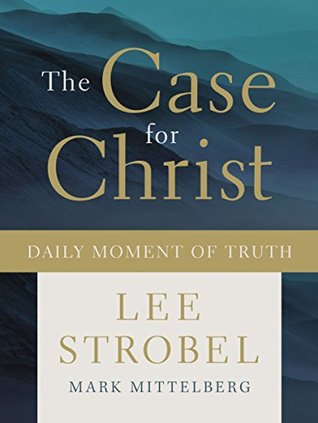
The Case for Christ Daily Moment of Truth - Lee Strobel, Mark Mittelberg
Shared by:rmoor
Written by ,
Format: M4B
Bitrate: 128 Kbps
Why do we believe what we believe? The Case for Christ Daily Moment of Truth , by leading apologists for Christianity Lee Strobel and Mark Mittelberg, offers fact-based, intelligent devotions to build a foundational faith. These 180 insightful writings will strengthen your spiritual knowledge and touch your heart with life-changing truth.
Each devotion is based on a scientific, historical, or biblical fact that will bolster your confidence in Christ. You will be inspired, encouraged, and equipped. A reflection at the end of each entry allows you to consider this new knowledge and how to put it into action.
In these thoughtful devotions Strobel and Mittelberg articulate the reasons why Christians believe what they believe. Combining the authors’ expertise in apologetics with scriptural application for daily living, this devotional will leave you deeply encouraged and well informed. Topics range from scientific discoveries to theological explanations, and each devotion is followed by a brief reflection, prayer, and thought to meditate on and talk about.
You’ll emerge with a deeper understanding of your beliefs. In the process, you’ll find your love of truth—and your passion to share it—growing each day.

| Announce URL: | udp://tracker.leechers-paradise.org:6969/announce |
| This Torrent also has several backup trackers | |
| Tracker: | udp://tracker.leechers-paradise.org:6969/announce |
| Tracker: | udp://tracker.coppersurfer.tk:6969/announce |
| Tracker: | udp://tracker.open-internet.nl:6969/announce |
| Tracker: | udp://tracker.opentrackr.org:1337/announce |
| Tracker: | udp://tracker.tiny-vps.com:6969/announce |
| Tracker: | udp://open.demonii.si:1337/announce |
| Tracker: | udp://tracker.torrent.eu.org:451/announce |
| Tracker: | udp://thetracker.org:80/announce |
| Tracker: | http://open.trackerlist.xyz:80/announce |
| Tracker: | http://tracker2.dler.org:80/announce |
| Tracker: | http://googer.cc:1337/announce |
| Tracker: | http://open.acgnxtracker.com:80/announce |
| Tracker: | udp://exodus.desync.com:6969/announce |
| Tracker: | udp://open.stealth.si:80/announce |
| Tracker: | udp://opentor.org:2710/announce |
| Tracker: | udp://tracker.dler.org:6969/announce |
| Creation Date: | Sat, 22 Jan 2022 18:41:13 +0100 |
| This is a Multifile Torrent | |
| The Case for Christ Daily Moment of Truth.nfo 1.16 KBs | |
| The Case for Christ Daily Moment of Truth.cue 10.51 KBs | |
| The Case for Christ Daily Moment of Truth.jpg 25.44 KBs | |
| The Case for Christ Daily Moment of Truth.m4b 590.48 MBs | |
| Combined File Size: | 590.52 MBs |
| Piece Size: | 1 MB |
| Comment: | Updated by AudioBook Bay |
| Encoding: | UTF-8 |
| Info Hash: | 4ed0a46a6374036cf9d76e134c52eba664486b54 |
| Torrent Download | Torrent Free Downloads |
| Tips | Sometimes the torrent health info isn’t accurate, so you can download the file and check it out or try the following downloads. |
| Direct Download | Start Direct Download |
| Tips | You could try out alternative bittorrent clients. |
| Secured Download | Download Files Now |
| Ad |

|


This post has 40 comments with rating of 5/5
January 22nd, 2022
non fiction?
January 22nd, 2022
Not History, dipstick
January 22nd, 2022
Mucho respecto to the uploader.
January 22nd, 2022
The atheists sure get triggered easily.
January 23rd, 2022
Well retro, the jesus blood cult has had the last 2000 years to make their case. That’s beyond fair & more than any other cult has got. In fact the jesus cult is still not getting taxed on billions in real estate. Throw some of that tax exemption my way for Christ sakes.
January 23rd, 2022
Make their case? And what year is it, pray tell? And why is it that year? That’s one helluvan impact right there.
I’m sure you’ll be thrown billions of dollars worth of tax exemption once you start engaging in billions of dollars/euros/rubles/rupees/pesos/reals/Earth credits worth of charity, education, health care, etc. etc.
You should begin with the utmost alacrity, in order to catch up on, what is it again? Oh yeah, almost 2000 years of work.
January 23rd, 2022
Render unto Caesar now: Should we be taxing the churches?
There’s big money in religion for some of the top pastors and evangelists. | CC
Therefore render to Caesar the things that are Caesar’s, and to God the things that are God’s. Matthew 22:15-22
In this famous biblical passage, Jesus made it clear to his followers that they ought to respect the laws of Caesar, and his taxes, and to respect the laws of God, and render support to his ministry, at the same time. In essence, even Jesus said to obey the taxes of Rome, onerous and unfair as they were, seeing no contradiction between the two states of mind. Taxes, for Christ, were to be paid by those of faith. The fairness, and the point, of those taxes were a conversation for another day, as taxes back in those times were simply payment to the ultra-rich for little in return. The rich of Rome demanded much, and gave nothing back (setting aside, for the moment, the usual “bread and circuses”).
Religious liberty, in the original sense of the term (freedom of worship) and not the bastardized propaganda newspeak that is promoted by the right wing (freedom to discriminate), is one of the cornerstones of American life. Like freedom of speech, it’s inconceivable to think of America without this free marketplace of existential ideas.
Religious liberty is so protected to the point that the federal government gives full and complete tax exemption to religious organizations, even to the extent of demanding neither a Form 1023, which grants tax exemption to other secular nonprofits, nor a Form 990, an annual return report required of other tax-exempt organizations.
In fact, such little disclosure, regulation, and transparency are demanded that our system of religious freedom is markedly distinct from such countries most similar to our own legal culture such as the U.K. and Canada. And it is quite a different picture from the dictates of the Emperor Tiberius that Christ had to deal with.
The idea of exempting religion from taxes was a noble one: No religious group would be financially pressured by the government, allowing whatever creed, sect, denomination, or community to be able to flourish without additional impositions for funding. But like a lot of high-minded ideas in America, it’s become twisted.
Now many are treating the tax exemption as a license to effectively “print money”: We have the disturbing (though not entirely new) phenomenon of the pastor millionaire or religious educator (such as Joel Osteen and Jerry Falwell, Jr. both worth over $100 million dollars, and Kenneth Copeland, the richest pastor in the world, worth $300 million dollars). The super-churches, such as the one Osteen had redesigned from a former NBA stadium in Houston,, are gaudy displays not of Christian humility, but rather corporate showcasing. The tax exemption is no longer a shield for a struggling religious community, but an outright tax dodge for some of the wealthy.
Needless to say, a tax exemption based on religion that can create millionaires needs to be re-addressed, and soon, because such an exemption, and such obscene exhibitions of personal wealth based on the contributions of their followers, is more destructive to the religious community as a whole than any tax would be.
With the growth of the internet and social media, it becomes evermore obvious that the ulterior motive of personal profit is behind many of these religious endeavors, at the same time creating cynicism and bringing much of Christianity itself into disrepute. When so much wealth is generated, and so little of it is being put back into the community, one who may be interested in religious study of any kind will immediately be taken aback by the sheer hypocrisy on parade. For every would-be convert pastors like Osteen and Copeland reel in, five more out there must be disgusted by what is openly manifested.
Kenneth Copeland, the country’s richest evangelist, shows off the private jet purchased with the contributions of supporters. | via Kenneth Copeland Ministries
A way can be devised to tax the religious rich without unduly interfering with truly struggling churches, synagogues, mosques, and temples, and every Christian and person of faith should support it. A proper system of taxing religious communities will take away a major argument against Christianity and other groups—that all those involved in some sort of leadership capacity are just in it for the money and the tax dodge, and that all churches are focused more on their financial statements than moral education and salvation. Allowing the Osteens and Copelands to get away with this way of moneymaking for so long has only opened the space for flagrant, stinking corruption across the entirety of Christianity.
A tax on religious organizations would also be a way to finally tap into the immense resources of the Catholic Church, which has holdings so vast and so opaque that no one really knows how much they own in the United States. It wouldn’t be much of a surprise if we learned that the Catholic Church as a whole, in just the U.S., made Osteen’s and Copeland’s organizations look like paupers! As a practicing Roman Catholic, I would like to see more of the Church’s money go into the community than just being used in worldly investments—or lawsuit settlements.
Think of what could possibly be done, and how much humanitarian work could be accomplished if a system of taxation were to be put through. For just the net worth of one Joel Osteen, we could build 28 commercial wind turbines—enough clean electrical power to power over 21,000 households. Or that would effectively provide enough power and then some to the 15,000 households in the Navajo Nation, which suffers from a systemic poverty that is the shame of the land. I’d sooner see people in such harsh conditions get electrical power than watch as yet another mega-church gets built to enrich the next prosperity preacher.
Wouldn’t that be for everyone’s benefit in the end? And wouldn’t that be more mindful of everyday people? Religious groups not paying their fair share of taxes also puts them on essentially the same wavelength as most amoral major corporations—the ones that through loophole and legislation, pay exactly the same amount as tax-exempt religions—absolutely nothing! These similar institutions regularly commit the cardinal sin of greed, and live more like Emperor Tiberius, demanding much from our society and giving nothing back (not forgetting our 24-hour streaming online entertainment).
January 23rd, 2022
Sounds like you have significant room for improvement over there. I have to admit to a surfeit of disgust over parodic movements such as the “Prosperity Gospel” & various other money-grubbing efforts; behaviours so remote from the actual spirit of Christianity as to be no better than base materialism.
However, these hardly represent the whole - at least in the global sense. Tax exempt status is crucial for the work & operation of charities, in addition to being important for the entire range of activities engaged in by real churches, incl education, health care, international aid, famine relief, etc. etc.
P’haps taxing business corporations appropriately might be an idea; & audit the airborne evangelists - the lads with the fleet of jets. If it’s undeserved, charitable status can be lost, of course. Particularly when this guy’s charity merely begins & ends @ home, as I suspect it does.
January 23rd, 2022
atheists still seething about the fact that virtually all historians agree that Jesus existed, I see
January 23rd, 2022
Demons frothing. Hilarious.
January 24th, 2022
Great book. For many reasons. Best if folks read first, then make comments! Thanks for this!
January 24th, 2022
Askatazun “virtually all historians agree that Jesus existed” errrmmm no! Where’s the proof?
January 24th, 2022
All tenured academics with pertinent specialisms agree on Jesus’ existence. (If you can come up with an exception, please do so.)
The non-existence con theory has become popular amongst non-scholars on the wub. Or, “internet scholars” I s’pose they should be termed.
It was not popular at the time of Jesus’ life, and in all the time following the crucifixion; even amongst the enemies of Christianity, although they had skin in the game, as ’twere. Their writings are free of such accusations & con theories. If it would be anywhere, it would exist in those writings. This, as Conan Doyle would observe, is the dog that didn’t bark.
January 25th, 2022
Thank jesus for Cheeses, only the baby jesus mind you. Not the hairy hippy one.
January 26th, 2022
There’s always one cheese fundamentalist.
January 26th, 2022
…& we’ve unearthed that fondue-mentalist.
January 28th, 2022
Sadly, once I looked into the actual writing of this book, it’s just bunk. The evidence presented in it is inaccurate, and Strobel’s story of how it came to be is straight fiction. Do some research outside of the authors words and you’ll see what I mean. It’s very poor journalism.
January 29th, 2022
The reason to cling to a historical Jesus is that if he didn’t actually exist, then Christianity is essentially baseless. But more importantly for Christian claims, he must have existed as the supernatural figure as claimed by the Bible.
Even though some apologists dismiss evolution out of hand, biology and science shows us that Genesis is doctrine that is utterly wrong. Biology severs the link between Adam and Jesus, which is crucial to the Gospel. With no Adam, no Original Sin. Jesus becomes the scapegoat of a nonexistent forebear, undermining the foundational basis for believing in both God and the value of Jesus Christ. Or maybe it was all just metaphorical, as if there was some reliable mechanism to determine what is or isn’t metaphorical in ancient text. God of the gaps shines bright.
Further, the idea that the only way to forgive is to have a scapegoat? Human sacrifice? Blood magic? That is petty and immoral. God’s own son needed to be tortured and killed because there was no other way but to pin all the debt on him and kill him, supposedly cleaning us of his own wrath. This demonstrates there is to be no forgiveness without punishment. No forgiveness without bloodshed. Completely horrible outdated ignorance from a cult of human blood sacrifice.
So then, having a plausible case for some level of historicity for Jesus is necessary as a foundation of apologetics. But extraordinary claims require extraordinary evidence.
The story around Jesus that historians agree with does not include any actual magic, miracles, or gods. The consensus is that the most likely historical path to Christianity is that an actual person, a first-century Jewish religious leader, become the mythological figure mentioned within the Bible. This is where the consensus ends.
Religions must presuppose their gods exists, since there is no supporting evidence for any god or any of the supernatural claims of any religion. God needs to be demonstrated before being offered as an explanation, yet no one can even show if gods are possible. We don’t have to rule any gods out, they have to rule themselves in. Agring a god into existence is not enough.
I digress. Mythological supernatural ‘gods’ do not require logical consistency, the definition is subjective. So since gods are not bound by logic, any arguments for such gods opt out of rational discourse. This is the reality, so it is no surprise we have anti-vaxxers, astrology, flat earthers.
January 31st, 2022
@ISeededForDays - Interesting piece, and worthwhile reading.
Evolution is wholly unproblematic, in spite of the claims of some American evangelicals & Islam. Genesis is poetry. St Augustine observed 1600 yrs ago (essentially, in the very distant historical past) that the worst way to interpret Genesis was in a literal fashion. He also himself proposed a model of evolution, unfolding over vast spans of time.
The Gospels do not hinge on any substantive link between Adam and Jesus.
Original sin is a doctrine of human psychology & moral evil. The redemption offered by Christ represents the sharing of the divine in human suffering, the very depths of that suffering in fact, & redeems/counters evil & suffering, through the power & example of agape, redemptive love. Weirdly (or p’haps not so much), this still inspires hatred.
The “God of the gaps” argument remains a red herring.
The existence of Yeshua is far from being an extraordinary claim, and has remarkable historical support, particularly for a non-elite member of society living during the First Century. A decidedly non-mythological figure, to be sure. The extraordinary spread, durability & success of Christianity, based on the life & ministry of Yeshua, is also historically established & undeniable.
As far as religion presupposing the existence of God, reason (the argument from contingency) presupposes an objective First Cause & prime mover (ruling the immanent universe in, as ’twere), & empirically we exist in a universe which responds to rational investigation. Why there is something rather than nothing. Being is intelligible, in this pivotal sense.
Were God to be demonstrated in the manner which you describe, worship would not be based on love or caritas; it would be based on fear, the craven worship of power as a brute fact. This would be diametrically opposed to the core principles of Judeo-Christianity.
Natural Law (incl human rights doctrine, conceived in Canon Law & based on Imago Dei & the dignity of the human soul) & natural theology are bounded by logic & reason (superlative stuff, really worth researching). This rational conversation has been in progress for millennia, long before the Church even created the university. Sapere aude, as Kant would advise.
February 1st, 2022
@caesar963 - Unimpressive perspective, so quick to dismiss evangelicals & Islam and merely arguing god into existence. What method are you using to dismiss Islam so quickly, when it also relies on faith, holy texts, and claims of prophets?
To claim remarkable historical support does not demonstrate anything supernatural, it merely shows what a particular set of people believed. The history is downright fascinating, and yes of course the extraordinary spread, (keeping in mind the religion of the ruler is often the religion of the realm), durability & success of Christianity is undeniable. However, a Christian from 2000 years ago would not recognize the Christianity of today, because religion is fluid and has tried to adapt to the modern world in many ways, perhaps in spite of itself. Surely you realize this, so it’s a bit confusing why you would bother to bring up what St Augustine observed 1600 yrs ago. But since you did, please explain how interpreting religious scripture in a particular way does anything to demonstrate the existence of any God?
Further, how do you know when or when not to interpret something literally? If Biblical interpretation is to be considered reliable, there must be clear structured rules and metrics to apply so that the extracted meanings are the same, or have a high degree of similarity. Instead, across religions we have remarkably different interpretations without any major statistically significant similarities. There is no uniformity or any quality control. It’s almost as if it’s impossible to find consistency in a delusion.
It is absolutely dishonest to pretend that there is any possible way to objectively and unambiguously determine which parts are literal and which parts are figurative. Without such a method, each Christian is free to pick and choose which parts of the bible they want to believe, and which parts they want to reject. Does that really sound like a good way for an omniscient, omnibenevolent god to spread their message? After all, what could possibly go wrong that way?
Or maybe I have it all wrong? Please demonstrate how your religion or any other religion provides its followers with a method to determine what is true and what is not.
Weather God of the gaps is a red herring or not does nothing to help establish any gods. And since the book that claims such a god can be read in virtually any way, it can mean anything to anyone depending on where they live, when they live, and the context in which they live. Rather like horoscopes, interpretations are generalizable and unfalsifiable, seemingly providing an explanation to retro fit any and all things. Not a problem for you I suppose?
Further, the Gospel being based on Jesus may be historically established & undeniable, but it does not establish magic or miracles. Your claim of absolutes is telling. Even if Jesus did everything the Bible claims, it still would not demonstrate a god. What underlying mechanisms could we investigate to get to that conclusion? None. Jesus could have had supernatural powers but this does not immediately make a gods existence true.
Outside of Biblical texts, there are no accounts of anything relating to his life. Nothing. All we have is historians talking to Christians decades later about what they believed. Many historians were around at this time, yet nobody mentioned Jesus. Was he not interesting enough? His miracles not magic enough? Including the Bible, there are zero known writings from anyone who actually interacted with Jesus while he was alive. References to him are from decades after his alleged death, and we have no accounts from anyone who actually met Jesus. There are no credible writings made at the time of the alleged life, death, or miracles of Jesus. This is because there is no god, and Jesus was not supernatural. He preached to reform Judaism and the coming of the rule of God, but nothing that happened with him attracted the notice or interest of any contemporary scribes. The things that would help corroborate his stories simply don’t exist.
Genesis is poetry? The Bible says things that we know are not true. It claims a geocentric universe with stars smaller than the earth, where plants and light were ‘created’ before the Sun. It claims, at one point, the entire world spoke only one language, including at least one snake. A true religion would not make claims that are demonstrably false, or not demonstrably true. If it’s claims can’t be shown to be true, by what standard can we call it true?
Unfortunately yes, evolution is a problem here, since it means the Adam & Eve story is false. The denial of a historical Adam & Eve means that the Bible’s story is not a representation of the truth. This is very different from what the church has told it for centuries as the Bible has been read, taught, preached, and believed. If there is no historical Adam & Eve, the Bible’s metanarrative is not Creation-Fall-Redemption-New Creation, is false. A false start to the story produces a false Gospel.
But by all means, claim blind faith is a virtue. Claim religion is all bounded by logic & reason. It’s just a red herring, because those claims do not any make gods existence true, no matter how many philosophers you quote, or how much virtue signaling (the church created university!) you use to try to argue that particular god into existence.
February 1st, 2022
More intriguing matter.
“quick to dismiss evangelicals & Islam…What method are you using to dismiss Islam so quickly” - As usual, I would caution against any unreasoned bigotry towards Islam & all of the great religions (I’m not saying that you are guilty of this). I consistently witness this mindless bigotry, nonetheless, on this site & elsewhere.
Here the issue is evolutionary theory; it’s not a dismissal to note that many Muslims hold that human beings have “always existed in this present form.” This is an objective rejection of evolutionary theory, Others hold a more reasoned view.
On my purported “dismissal of evangelicals” - You yourself said “some apologists dismiss evolution out of hand” - Yes. Precisely, some evangelicals engage in this.
“shows what a partic set of people believed” - Indeed, it reflects their witness & experience.
“the religion of the ruler is often the religion of the realm” - Yes, that would be a Westphalian doctrine (1648); that the religion of the prince would be the predominant religion of their specific sphere.
“a Christian fr 2000 yrs ago would not recognize Christianity of today” - While it’s a truism to observe change as a constant, the core principles of Christianity held by the early Church (incl St Augustine) remain those held by the vast majority of Christians.
“why bring up…St Augustine” - Augustine is the most influential Christian philosopher & theologian in history. His modes of interpretation have been radically influential. (There was also his proposal of a model of human evolution, which was germane in the context of the theory). It ought to be also noted that, although St Augustine’s judgment can be regarded as the locus classicus on this point of interpretation, it actually usefully exemplified the position of the Church in the broader sense (Church Tradition; Magisterium; etc.).
“interpreting religious scripture in a partic way does anything to demonstrate the existence of any God?” - As I mentioned, were God to be demonstrated certainly, worship would not be based on love or caritas; it would be based on fear, craven worship of power as a brute fact. Therefore, diametrically opposed to the core principles of Judeo-Christianity. Demonstration of certain existence would serve to vitiate free will & ethical belief, properly understood.
However, derived from the multifarious Judeo-Christian texts, there are a myriad of arguments which conduce towards the First Cause: the ontological argument; the argument from contingency; the moral argument; the cosmological argument; the argument from conscience; the comprehensibility of creation; the teleological argument, etc. etc. In fairness there are dozens of these, some familiar, some less so.
“Further, how do you know when or when not to interpret something literally? If Biblical interp is to be considered reliable, there must be clear structured rules to apply so that the extracted meanings are the same, or have a high degree of similarity.” - Of course, Biblical hermeneutics & exegesis represent a venerable tradition. As with, in a sense, statutory interp, the approach is determined by the text.
Given the existence of multiple genres within the Judeo-Christian texts (incl poetry, law, wisdom, proverbs, parable, prophecy, historical narrative, epistle, apocalyptic writings, gospel, psalms, etc.) - each requires a separate, established set of interpretive devices. For inst, we approach drama differently from prose, poetry, essays, philosophy, science, history, etc. The parameters & conventions are different for each.
There are several established, recognised interpretive approaches, incl lexical-syntactical analysis; historical/cultural analysis; contextual analysis; theological analysis; & special literary analysis.
Also, there exists the necessity to take the normative perspective of the text into account, & to be ever-conscious that receptivity to texts can & does alter. Moreover, I note that a full appreciation of historical issues & processes is pivotal (as in every area of life, I think).
The texts contain varied levels & dimensions of allegory, figurative language, metaphors, similes & literal, prosaic language. For example, the apocalyptic writings & poetry have more figurative & allegorical language than does the narrative or historical writing. These must be addressed, and the genre recognised to gain a fuller understanding of the intended meaning.
It’s analogous to a diverse library of discrete texts rather than a single volume. I appreciate that it’s a considerable academic area, engaging associated disciplines. This involved complexity does indeed provide cultural & spiritual richness, in addition to concomitant challenges.
To the point, the poetic nature of Genesis (Garden of Eden, etc.) is marked by its level of figurative & allegorical language. Echoing the earlier observation on St Augustine, as he said, and as tradition has followed, the literal interpretation of the poetry in Genesis is the worst possible approach. That principle of classical rhetoric - decorum - is fully engaged here. Recall that this is the poetic, theatrical & textual theory concerning the fitness or otherwise of a particular text’s style. However, as you said, some evangelicals in America persist in this error, leading to some notorious & humourous misunderstandings/contradictions regarding history & the archaeological/fossil records.
As for contention & confusion, it is entirely characteristic of our flawed & fallible human nature, our free agency, that there will be disagreement, diverse opinions & uncertainty. Absolute certainty is not to be attained in this realm or connexion. Much can & does go wrong, this is our human subjectivity & condition. Our social dynamics are replete with communication breakdowns, as we know.
My own denomination (which I of course rejected in my teens) always observed that there is a significant measure of truth & moral value in all religions & faith/philosophical traditions. Much of the core values are shared across traditions & cultures, with many of the aspects which prompt division often being of relatively minor import - at least from a posited “God’s eye view” - so to speak.
As for meself, I’d best be described as an interested quester, trying to remain open to the great philosophical ideas which represent our common inheritance & magnificent tradition.
“Outside of Biblical texts, there are no accounts of anything relating to his life. Nothing. All we have is historians talking to Christians decades later abt what they believed. Many historians around at this time, yet nobody mentioned Jesus.” - Apart from the Gospels, Acts & Epistles, Jesus/Yeshua is present in Jewish oral tradition, incl the Talmud, Mishna, together with commentary, Gamera. In addition to this we have histories, Josephus, Jewish Antiquities, Tacitus; Thallus (52AD) who is p’haps the earliest secular writer; the Syrian philosopher, Mara Bar-Serapion; the historian, Phlegon, also mentioned by Julius Africanus; Pliny the Younger; Suetonius; Lucian of Samosata; Celsus; etc.
“References to him are from decades after his alleged death” - The earliest Pauline Epistle has been dated to possibly six years after the crucifixion of Jesus/Yeshua. This proximity (even the proximity of several decades) is remarkable for the contemporary circumstances; also, as I observed, for a non-elite member of society, in what was essentially an imperial backwater.
Moreover, regarding technical & practical considerations of historiography, it must always be noted that all the writings we have concerning Jesus/Yeshua are, of necessity & by definition, the surviving writings. Potentially, there were always more records, histories, chronicles & epistles which do not come down to us. For inst, there would have been many more Pauline Epistles, in addition to writings relating to & by activists, supporters & opponents. Often we have references to, & synopses/epitomes, of works which have not survived (this is true of many of the writings of Tacitus himself, for example).
It is also a critical point that culture at the time was far less literary & more oral in character, a key historical fact.
I would remind you that the earliest extant history of Alexander of Macedon dates to almost four centuries after his death. Alexander was also a figure from the higher echelons of his society & culture.
“virtue signaling (the church created university!”) - Indeed, the university of Bologna being the first. This was a new, multi-disciplinary, educational institution; with the University of Paris/Sorbonne et al, growing out of the famed Cathedral Schools, which originated in the Fifth Century. Establishing & fostering the nascent university system was a natural development for the medieval Church, being, as historian Lowrie Daly observes, “the only institution in Europe that showed consistent interest in the preservation and cultivation of knowledge.”
In spite of barbarian attacks & societal collapse, the Church, & in particular, the network of European monasteries, preserved literacy & extended learning, copying out the invaluable works of the Classical era in their many scriptoria; also incorporating Plato, Aristotle, Cicero et al, into their curriculum & philosophical framework.
The earliest universities were developed under the direct aegis of the Church by papal bull as studia generalia. The university is a cultural artifact of the Catholic tradition, formed by a union of groups of students and teachers who arose out of the traditional monastery and cathedral schools. Colleges were added later to complete the formation of the student through moral & spiritual discipline.
Broad recognition of this educational standard was/is key. The master’s degree entitled the bearer to teach anywhere in the world (ius ubique docendi). This was affirmed in Pope Gregory IX’s document pertaining specifically to the University of Toulouse. These institutions were unknown to the Roman Empire, but vital to modern culture. This is central to the history of Europe, and to the history of ideas.
February 1st, 2022
Apologies for my extraordinary length.
February 1st, 2022
No apologies necessary. I appreciate the effort.
“a significant measure of truth & moral value in all religions & faith/philosophical traditions”
More value perhaps, but truth? Absolutely not. Religion is a primitive way to understand the world and behave within it, completely overshadowed by empirical knowledge from science, and completely outclassed by ideological and philosophical discourse.
The measure of all religions, all gods, all creation and afterlife myths that is true, is that they were all about us, because they were made up by us. Why God loves us, why we matter, what our purpose in life is, what happens after we die. They only look similar if we ignore all the differences and define the similarities in vague enough terms, which is not insightful. Religions are mutually exclusive, and devise. For one to be correct, the others must be wrong. How can we determine who is correct if there is no reliable method to tell which faith is correct over another’s, or between gods known to be fiction and a god that is actually exists?
Ever heard of cargo cults?
Stated plainly, religion is ultimately reducible to belief in unverifiable supernatural entities and imperceptible realms, belief in things beyond investigation and understanding. Ideologies and philosophies are expected to demonstrate their claims, but with religion, that is emphatically not the case because religion does not establish any truth to supernatural claims.
Religion’s foundational framework is ultimately dependent on : faith.
It doesn’t just encourage fundamentally irrational behavior, it requires it. Faith in the imaginary; invisible and intangible beings, inaudible voices, imperceptible realms, unverifiable past events, undetectable forces, and judgments that happen after we die.
This means it has no reality check.
Without a reality check, it is uniquely armoured against criticism, questioning, and self-correction, or against anything that might stop it from spinning into absurdity, denial of reality, or grotesque immorality. It fosters a mindset driven by misinformation, relying on discrediting doubt, suspending skepticism, and creating a lack of respect for evidence. In touting blind faith as a virtue, misguided concepts are perpetuated into future generations. Their survival mainly depends on proselytizing to impressionable children. This means it is prone to extremism. It can be used to justify or rationalize anything. Harmful beliefs and practices may be protected under the veil of religion.
Religious faith is demonstrably unreliable, because it can lead to mutually exclusive, contrary positions. We would be better served by developing healthier ideologies, philosophies, and coping mechanisms.
February 1st, 2022
So many - essentially all - of those criticisms can actually be laid at the blood-stained feet of all extreme, political ideology & the toxic tribalism it creates. Purely materialistic, mindless, anti-theist ideologies resulting in the unimaginable murders of several hundred million human beings - wholly unprecedented in scale & savagery.
As an exercise to demonstrate, I merely epitomise here: the toxic ideologies & mindless political “isms” of the last century - “encourage fundamentally irrational behavior” = Genocide & ideological fundamentalism.
“Faith in the imaginary; invisible & intangible, imperceptible realms” = Political Utopia/No place.
“This means it has no reality check” = Precisely.
And, most tellingly, your passage here reads exactly like a history of all the genocidal 20th century ideologies, word for word: “Without a reality check, it is uniquely armoured against criticism, questioning, and self-correction, or against anything that might stop it from spinning into absurdity, denial of reality, or grotesque immorality. It fosters a mindset driven by misinformation, relying on discrediting doubt, suspending skepticism, and creating a lack of respect for evidence. In touting blind faith as a virtue, misguided concepts are perpetuated into future generations. Their survival mainly depends on proselytizing to impressionable children. This means it is prone to extremism. It can be used to justify or rationalize anything. Harmful beliefs and practices may be protected under the veil of” = toxic political ideology.
Moreover, such mindless doctrines “can lead to mutually exclusive, contrary positions” = Orwellian Doublethink.
You proficiently spell out the incalculable dangers of political ideologies, as we all know only too well.
Merely observe the genocidal, slave state ideologies of the 20th c - the most murderous & the most ideological century in human history. Forced famines, concentration camps, gulags, genocide, eugenics, wholesale murder of the most vulnerable, industrial levels of torture, despotism, secret police, brutal terrorism, narrow indoctrination of populations (including children, of course), human experimentation, Great Leaps Forward, Five year plans, cultural revolutions, invasions, occupations, eternal war for eternal peace. Incessant barbarism & cruelty is all they offered; in addition to total, ignominious societal, economic, political & cultural failure.
Genuinely, no thanks. Given the choice, humanity will demur. That’s why such toxic ideologues never give people the dignity of uncoerced volition.
Whereas, a religion of love, charity, forgiveness, human dignity, respect for life at all stages, justice, co-operation, & reaching the fullest human potential - yes indeed, I’m all for it.
The New Testament’s unprecedentedly sophisticated idea of the equality of each human soul - this concept was utterly unheard of. Indeed, we still haven’t risen to this conceptual potential, given our flawed nature.
Some advances were indeed made. As mentioned, Natural Lawyers creation of human rights doctrine, conceived in Canon Law & based on Imago Dei & the dignity of the human soul. International law from the same source, including the concept & offence of Crimes Against Humanity (derived from Aquinas’ conceptualisation of Natural Law) with regard to the international jurisprudence of the Nuremberg Trials. Just War theory should also be mentioned in this connexion (derived from Augustine & Aquinas).
On a further historical note, relating to the history of ideas, the philosophical impact of Christianity should also be observed. Prior to Christianity, the conception of human personhood in the Classical era was extremely diminished & materialistic. The idea we have, which has been derived from Christian ethics, of altruism, caritas, & the dignity of the individual soul, did not feature in Classical culture.
This is exemplified by the decidedly non-Christian - & profoundly popular - tradition of torture & murder as mass entertainment spectacle, in the great games & gladiatorial contests which were widely held. Not forgetting the tradition of human & child sacrifice practiced around the Mediterranean. And the exposure of “unfit” & “imperfect” children - abandoned to nature & the elements. And the general, appalling attitude towards disability - which was even held in the comparatively civilised culture of the Jewish people.
It could be speculated that, in many senses, we in the West are returning to this significantly diminished, materialist view of human personhood.
February 1st, 2022
So Christianity is the best thing ever. Got it.
Religion is divisive. It seems you judge me, the non believer, as toxic scum. So if all religions preach peace, why can’t they achieve it?
Atheism is an ideology that promotes tribalism? No. Atheism isn’t an ideology. There are no tenets. There’s nothing instructive. It describes a single stance on a single issue. Do you understand?
Religion promotes tribalism. Infidels, heathens, heretics; religion divides insiders from outsiders. Rather than assuming good intentions, adherents often are taught to treat outsiders with suspicion.
“Be ye not unequally yoked with unbelievers,” says the Christian Bible.
“They wish that you disbelieve as they disbelieve, and then you would be equal; therefore take not to yourselves friends of them,”
says the Koran (Sura 4:91).
At best, this discourages or forbids the kinds of friendships and marriages that helps clans and tribes become part of a larger whole. At worst, it dehumanizes and sees outsiders as enemies of God and goodness, lacking in morality and not to be trusted - potential agents of Satan. Believers may huddle together, anticipating martyrdom. When simmering tensions erupt, societies fracture along sectarian fault lines.
So instead of addressing any of my points, you point fingers. But you made a slight mistake. None of the deaths you write about were done in the name of atheism. None. Zero.
Those deaths you write about, are largely because of sociopathic dictators. Men like Stalin, Mao, or Hitler created cults of personality or political religions, which ascribed godlike powers to the state and its leadership.
The reason why these horrible dictators attempted to abolish religion is because they use precisely the same psychology and tools as religion in order to indoctrinate their population into accepting them as a leader that is not merely a person, but something more, something deity like.
They don’t want the competition. Those places were not and are not atheist states. They are religious dictatorships with the leader and government and ideology as the deity and religion. That more resembles religion than atheism.
No one has ever started a crusade for atheism, no one has created atheistic states where religious people are killed, no one has started a jihad in the name of atheism.
Why even bring up those deaths when religious history is also so stained with blood? From blasphemy to glorified suffering, human sacrifices and witch burning, the Crusades, crimes against humanity, against science, medicine, reason, and the enlightenment. Perhaps worst of all - religion has been used as a patriarchal tool to elevate the status and power of men over women. Is that good for the world?
However much religion may try to rewrite or make us forget its history, it still tries to obscure the fact that it depends upon proselytizing to impressionable children for its survival.
A bit of a tangent perhaps, so back to atheism. Even if it was the complete worst ideology, this would not mean that god exists. If all your religious flattery was actually merely humble praise of how great it can be, it doesn’t mean that god exists. I do not deny the utility of religions, only that they are based on a false premise.
If god exists, why didn’t it stop some of those deaths that you seem to find so abhorrent? Why did t not choose a more convincing method to spread its word than that of ancient literature subject to centuries of translations and revisions?
It’s been nice chatting with you Strawman963. That said, I am done here unless you wouldn’t mind answering a single question: If your god doesn’t exist, how could you know?
February 2nd, 2022
“Religion is divisive” - Indeed, everything is divisive. Our human condition.
“It seems you judge me…as toxic scum” - Absolutely not the case. Please don’t think that. There’s enough negativity around.
“if all religions preach peace, why can’t they achieve it?” - My own take: peace, in the larger, global sense of the term, is somewhat akin to perfection, wholly unattainable. We can endeavour to practice it individually, however.
“Atheism is an ideology that promotes tribalism?” - Not what I said, of course. I specifically identified the “genocidal, anti-theist ideologies” of the 20th C, which were many & varied; or, alternatively, all the same, given the results.
“Do you understand?” - See above.
“Religion promotes tribalism…divides insiders fr outsiders. Rather than assuming good, adherents oft are taught treat outsiders w suspicion.” - Here, the human condition again. In-group, out-group ideologies & social dynamics, politics, nationalism, ethnicity, culture, regionalism, food & style choices, class, education, gender, age - even sport. Are you “one of us?” One village/townland/burgh/city/county/state/country/continent/planet versus another. Also in sub-categories within the “polis” - Paris: Left Bank vs Right Bank; Eastenders; Manhattanites; here in Dublin, Northside vs Southside. Additionally, it’s important to recall & mention that religion can also bring people from vastly diverse backgrounds, cultures & nationalities together. When we say it’s all bad, we truly miss the point. If it was wholly negative, as you say, it could not really endure. People also will the good for themselves.
From the New Testament: “I say to you, love your enemies and pray for those who persecute you.” Matthew 5:44
“Bless those who curse you, pray for those who mistreat you.” Luke 6:28
Alternatively, “Always forgive your enemies; nothing annoys them so much.”- Oscar Wilde
“So if they remove themselves from you & do not fight you and offer you peace, then Allah has not made for you a cause [for fighting] against them.” Surah An Nisa 4:90
“And if they incline to peace, then incline to it [also] & rely upon Allah. Indeed, it is He who is the Hearing, the Knowing.” (Surah Al-Anfal 8:61)
At worst, it dehumanizes & sees outsiders as enemies” - Again, the sanguinary history of the ideological 20th century.
“Societies fracture along sectarian fault lines.” - Not the end of the story; there is also a consistent impulse & drive towards peace.
“So instead of addressing any of my points, you point fingers” - P’haps, self-awareness? Also, you didn’t read my point-by-point response? You had said before that you appreciated it, as I appreciated many of your remarks. The history of the last century & of the pervasive ideologies couldn’t be more relevant, as are the arguments & historical events associated with religion.
“But you made a slight mistake. None of the deaths you write abt were done in the name of atheism. None. Zero.” - Oh, dear. Truly? Not any of the millions of ideologically anti-theist persecutions, murders, & human rights abuses of all the explicitly anti-theist ideological regimes in Russia, China, Nth Korea, South-East Asia, Cambodia, South & Central America, & throughout Africa? Not one? The specific targetting of Orthodox clerics, priests, nuns, ministers & missionaries?
Not even the most militantly ideological anti-theist would make that claim, even out of gross expediency.
The atheist & anti-theist genocidal ideological regime in Russia as a case in point. According to Lenin, a communist regime cannot remain neutral on the question of religion but must show itself to be merciless towards it. There was no place for the church in such a state.
Even before the end of the civil war & the estab of the Soviet Union, the Russ Orthodox Church came under the persecution of the Communist govt. The Soviet govt stood on a platform of militant atheism, viewing the church as an independent, alternative voice with a great influence in society.
In Aug 1920 Lenin wrote to E.M. Skliansky, Pres of the Revolutionary War Soviet: “We will choke by hand the clergy. There will be an award of 100,000 rubles for each one hanged.”
The Soviets estab atheism as the only truth (see also the Soviet or committee of Znanie which was until 1947 called The League of the Militant Godless). Criticism of atheism was strictly forbidden & sometimes led to imprisonment.
Some actions against Orthodox priests & believers along with execution incl torture being sent to prison camps and/or labour camps or also mental hospitals Many Orthodox (along with peoples of other faiths) were also subjected to psychological punishment or torture and mind control experimentation (see Piteşti prison).
In the first 5 years after the Bolshevik revolution, 28 bishops & 1,200 priests were executed. This incl people like Elizabeth Fyodorovna, a monastic. Along with her murder was Varvara Yakovleva, a sister from Elizabeth’s convent. These & others were herded into the forest, pushed into an abandoned mineshaft and grenades were then hurled into the mineshaft. Her remains were buried in Jerusalem, in the Church of Maria Magdalene.
The Soviet anti-religious campaign & persecution in the 1920s & 1930s incl the sixth sector of the OGPU, led by Yevgeny Tuchkov, aggressively arrested & executed bishops, priests, & devout worshippers. Some 20,000 people were executed just outside Butovo, incl many clergy.
The church survived underground, and Freeze argues that the persecution in some ways made it stronger: The “Blood of the Martyrs” phenomenon in evidence.
According to the official data of the govt Commission on Rehabilitation: in 1937, 136,900 Orthodox clerics were arrested, 85,300 of them were shot dead; in 1938, 28,300 arrested, 21,500 of them shot dead; in 1939, 1,500 arrested, 900 of them shot dead; in 1940, 5,100 arrested, 1,100 of them shot dead.
You can see from the data, they were literally being killed off.
The Solovki Special Purpose Camp was estab in the monastery on the Solovetsky Islands in the White Sea. Eight metropolitans, twenty archbishops, and forty-seven bishops of the Orthodox Church died there, along with tens of thousands of the laity. Of these, 95,000 were put to death, executed by firing squad. Fr. Pavel Florensky was one of the New-martyrs of this partic period as well as Metropolitan Joseph (Ivan Petrovykh).
Many thousands of these victims of persecution were subsequently recognized in a special canon of saints known as the “new-martyrs & confessors of Russia.”
So, in a sense you’re right; “not one or not a single murder was done in the name of atheism” - in actual fact, globally, the real numbers would be - at this stage - countless. Somewhere inside that awful total of 150 million human beings.
“Those deaths you write about, are largely because of sociopathic dictators” - It’s not possible to so conveniently separate ideological murderers from the toxic ideology which drives & shapes them. They act in pursuance of their ideological objectives. Their ideological commitment facilitates the most awful, inhuman & merciless actions. It created the most bloody & murderous century in human history.
“They use precisely the same psychology & tools as religion” - At its best: charity, forgiveness, love, hope, extreme altruism, turning the other cheek, justice, the university, the hospital, the concept & doctrine of human rights? They use these? I’ll have to respectfully withhold agreement on that one.
They are strictly ideologically materialist & anti-theistic in character. Every time they go wrong (which is every time) - remaining ideological adherents will try to claim that they were something else, or their opposite. No True Scotsman - merely rinse & repeat. Multiple manifestations at this point.
“No one has ever started a crusade for atheism” - Most of the toxic ideologies were specifically internationalist in their objectives (”World Revolution”), supporting & exporting revolutionary terror, espionage, subversion, etc. globally. When they weren’t ruthlessly invading neighbouring states, of course.
“no one has created atheistic states where religious people are killed” - Again, see above. And the bloody history of the 20th century.
“crimes against humanity” - A legal doctrine based in Thomistic Natural Law, Canon Law, & the Church-created university tradition.
“science, medicine, reason” - Which were also promoted by the Church-created university system & hospitals. And the works produced/preserved in monastic scriptoria & Cathedral Schools.
Much that was good was covered by the Enlightenment (Beccaria, the philosophy of Kant); also much that was truly evil. Amongst these: “scientific” racism; the totalitarian extremism manifested in Rousseau’s political theories - which legacy I have explored; the consequent French Revolutionary Terror (which also featured widespread murder & atrocities by ideological anti-theists) & wars; mass murder & widespread barbaric cruelty - notoriously in Vendée; European invasions; eventually resulting in the “benevolent” despotism & autocracy of Napoleon, the suppression of freedoms, & the reintroduction of slavery in colonial territories. Added to this was the consequent rise of European nationalism in response. So, when considering the repercussions & outcomes of the Enlightenment, we must also be mindful of the short, medium, & long-term, deleterious & disastrous factors, as we know.
“worst of all, a patriarchal tool to elevate the status & power of men over women. Is that good for the world?” - Important to firstly note the treatment & subjugation of women & gay people under the ideological regimes of the last century; such as the use of concentration camps for gay people used in Cuba - and condemned by liberal democracies & all decent human beings.
The Church was also the only institution for many centuries which educated women, giving us people like Hildegard of Bingen - a polymath who was active as a writer, composer, philosopher, visionary & as a medical writer & practitioner.
Moreover, prior to Christianity, women were traded as chattel in marriage. Due to Christianity’s doctrine of the individual, dignified human soul, equal dignity & Imago Dei, the Church insisted that every marriage required the public, witnessed, express consent of the woman. This was wholly unprecedented.
Where did this dangerously radical thinking originate? “There is neither Jew nor Gentile, neither slave nor free, nor is there male and female, for you are all one in Christ Jesus.” St. Paul, Galatians 3:28.
Oh yeah. That.
“However much religion may try to rewrite or make us forget its history,” - I’d just be thankful if people actually knew at least some of their history - like the origins of the university, for inst. None of this is secret, hidden history. If formal education is lacking, of course, it just takes some curiosity & a measure of research. Most people know nothing about the past, merely a few wholly inaccurate, puerile, pop culture factoids.
“it still tries to obscure the fact that it depends upon proselytizing to impressionable children for survival.” - Yes, somebody, please stop teaching about love, charity, forgiveness, tolerance, justice, peace & the life of Jesus of Nazareth. Merely indoctrinate them with genocidal ideology instead. Recall that just such materialist indoctrination did actually happen to one-third of the world’s population over the last century. We ought to seriously reflect on just one instance - what is happening to the Uyghur people under just such an ideological regime. Read the reports from Amnesty, Human Rights Watch & the international NGOs.
“back to atheism. Even if it was the complete worst ideology, this would not mean that god exists” - We cannot put metaphysics under a microscope - it is known, Khaleesi. This is in the nature of metaphysics. (When was the last time any of us held Being or Justice in our hairy paws?)
“they are based on a false premise” - Given that this is a posited assertion, it ought to be pointed out here that such a statement cannot be demonstrated or proven. Consequently, it is merely another interesting opinion.
Here, you’re erroneously assuming your own subjective incredulity as an absolute metaphysical fact. An internet phact, in a sense.
“If god exists, why didn’t it stop some of those deaths that you seem to find so abhorrent?” - This is the nature of free will & meaningful agency; the problem of Moral Evil; the dignity of individual choice. If volition is to mean anything at all, it must be uncoerced & unencumbered. Without evil, we could not know good. If we could only chose the good (if we were fully causally determined - without even the fig leaf of compatibilism), that would not be choice then, would it?
(”those deaths that you seem to find so abhorrent?” - Do you not find them abhorrent as well? Imagine ideologues actually planning a famine - removing food from starving men, women & children. Just because of their broken, failed, morally bankrupt, ideological doctrines.)
“Why did t not choose a more convincing method to spread its word than ancient literature subject to centuries of translations & revisions?” - The medium was not the message - the message was the message.
And things get ancient eventually.
Nice chatting with u 2 - incidentally, where were the straw men at? Have they been fed & watered?
“I am done unless u wouldn’t mind answering a single q: If ur god doesn’t exist, how could you know?” - Well, that’s a poser & no mistake. An epistemological matter. There are many things that cannot be known with certainty, or fully established, but it is nonetheless rational to accept their existence. Just a few of these: we cannot prove, but typically accept, that other minds exist; we cannot prove, but typically accept, that life is meaningful; we cannot prove, but typically accept, the reality of history (this engages Descartes’ “Evil Demon”), the impossibility of determining whether the past was of recent generation - merely generated with the appearance of age; the certain existence of the external world (many such metaphysical examples); we cannot prove the validity of ethical beliefs concerning statements of value, for inst, that murder & rape are objectively wrong; also, aesthetic judgments (the beautiful, like the good) can’t be proven; logical truths cannot be proven, they must be assumed, for inst, - the law of noncontradiction, this axiom must be presupposed, it can’t be proven without reference to itself, ergo, arguing in a circle. Similarly, the law of identity.
(Recall Kant in this connexion, on the existence of the external world, the radical lack of accuracy/fidelity of sensory data, the distinct realms of phenomena & noumena - the impossibility of ever truly being able to know something for what it truly is - “the thing-in-itself”)
We must trust & have faith that such phenomena are valid - and we are rational to do so. Of necessity, human beings must have faith in virtually every dimension of their lives. It’s wholly ineluctable. We cannot have direct, perfectly reliable experience of each discrete event & aspect of existence.
February 4th, 2022
Dang our responses keep getting longer, don’t they?
Moralizing does not demonstrate a supernatural deity.
Explaining ad nauseum about the utility of [your particular] region does not demonstrate a supernatural deity.
Condemning this so called atheist ideology (I’ll concede the point you were making, though atheism has no ideology) does nothing to demonstrate a supernatural deity.
These are apologist tactics that are only useful on the faithful, since they may need all the ammunition they can get, but it won’t work on someone skeptical without religious faith.
Quoting scripture, no matter how eloquent the prose or ideas, does nothing to demonstrate a supernatural deity.
Yes I understand certainty. Do you understand metaphysics? It is abstract theory with no basis in reality. If something has no evidence we would be best in holding off believing it.
Your mention of Justice is telling, because Justice does not exist in and of itself. There aren’t some Justice particles floating around in some ether. Justice is concept of moral rightness based ethics, rationality, law, natural law, religion, equity and fairness ect, ect. Justice is subjective, and can only be measured by actors aware of justice. There is no justice for rocks.
This is just the same as gods - they are subjective concepts. They do not exist in reality.
This of course presumes you were arguing for a god that interacts with the universe, such as those preached about in holy text. Those that are responsible for things, and interact with the our lives, as most religions claim. Any interactions with reality would necessarily leave traces in reality, and thus subject to investigation. A deistic god, who does not interact with reality, is functionally no different than no deity at all, and I don’t see anyone worshiping such a deity.
We have much better evidence that other people’s minds exist because of empathy. People can say things like ‘I think, therefore I am’. We can relate to this, and we can also listen, touch, see, heard, even taste others. But god never does anything like this, so no it is not remotely the same. See what I mean about strawmen? You seem well versed at twisting language this way, but I don’t mean to say you are doing it intentionally.
No we don’t have faith, we have trust. Even if we cannot claim 100% certainty here, it’s only religion that seems to bring this up, since god claims have nothing, and religions tend to be based on gods. Faith in the religious sense is different.
Religious faith is a strong belief in a God (or in the doctrines of a religion) based on spiritual apprehension, or knowledge based on God’s revelation, rather than evidence or independent reasoning. The Bible defines it as confidence in what we hope for and assurance about what we do not see.
By definition it is a process that bypasses any need for evidence. This should tell us all we need to know. If someone doesn’t take evidence seriously, why should their opinions or claims based on faith be taken seriously?
Religion has its origin in imagination, rather than evidence. When there is no logical evidence based reason to believe, then we see the true source - deeply and fundamentally emotional attachment. Once we have an emotional connection we are more prone to lean into it psychologically. Beliefs that have no need for evidence no longer need a defense.
Faith is an excuse people give when they do not have a good reason to believe in something because if they had a good reason to believe, then they would not need to appeal to faith. Accepting anything on faith is admitting it cannot be accepted on its own merits. This is the power of pretend - literally make believe
Is there any position that can’t be justified by appealing to faith? No. With faith, we can justify anything, since it can give no indication of what is true. It can lead to mutually exclusive, contrary positions and incorrect conclusions. It is demonstrably unreliable and has no method of demonstrating truth. If something can be used as a justification for everything then it shouldn’t be used as a justification for anything. We should withhold belief until there is enough evidence, rather than just pretending to know when we don’t actually know.
Your little dig at the law of logic is cute. Sure, I will grant you the following presuppositional axioms: reality exists and is consistent with itself. Rationality is rational to the extent that it continues to be reliable.
The reason for this presupposition is because solipsism is unfalsifiable. Nothing else is presupposed. We do not assume that electricity will work tomorrow the same way it works today, but based on the evidence, and deductive reasoning, there is an extremely high likelihood that it will.
What would it mean if these weren’t true? Essentially reality would be an unknowable chaos where cause does not link to effect. That is not the world we see around us, but I don’t know why I even bothered to reply since you will gloss over what I am saying because of your delusion. It comes of as rude, the angry atheist trope, but you mentioned you were religious when you were young, unless I misinterpreted?
Teaching children to accept religious doctrine as the default assumption before they learn to examine the validity of those assumptions is deliberate. https://biblehub.com/proverbs/22-6.htm
Children are impressionable, and will accept nearly anything (tooth fairy, easter bunny) and will likely continue to accept such things if those views are reinforced. It convinces believers to view reality through an irrational framework for the rest of their lives.
Religious institutions learned early on that if they indoctrinate people early enough, they will revert to their theistic mental framework later in life. Once something is first recognized, it is more easily recognized, even if what is being recognized is not actually true. If we have a theistic belief structure that teaches supernatural things are true, or likely to be true, then when we see things, or feel things, or consider aspects of reality, we will likely default to using theistic reference points to validate those views. It becomes more difficult to discount religious bias when the supernatural is tethered to such a belief structure.
Religion has fostered some strong cultural tactics:
That religion operates in a different realm from reality,
That it’s unfair to hold God to normal standards of evidence,
That skepticism is the same as cynicism, fanatic militancy, or nihilism, or as you put it, that atheism is a toxic genocidal ideology,
That criticizing religion is inherently arrogant, intolerant or rude,
That letting go of religious doubts is a liberating act of love.
the ‘because God’ arguments which dismiss valid curiosity or questions.
Think how this affects the minds of children. These ideas divert and undermine the ability to recognize when religion is absurd, implausible, or even immoral. When engaging in religious activities, it’s highly dependent on subjective emotion and the creative interpretation of their experiences. It reinforces what they already uncritically believe.
Cheers - hope you and your God have a nice weekend.
February 5th, 2022
Tell u what, I did warn abt my unfeasible length. There was a lot of history in the last one (Russia) - pertinent & worth exploring - but I’m never sure if people read, or can even sustain interest in, long posts, esp with our attention spans (& collective IQ) in full retreat. I’ve always loved history, but a lot of folks regard it as something of an acid bath (there again, Russia).
“moralising” - No, that’s why I keep emphasising our (collective) flawed nature.
“Explaining ad nauseum abt utility [ur] region doesn’t demonst deity” - I think most of the relig traditions have superb points, which goes to explain their success & durability. Also, the reason I’m countering so much negative stuff is when I hear the (ad nauseam) critique of relig - it’s all unconditionally negative. I mean, to the most absurd degree (ad infinitum). To the point where, there would have been no way something would’ve survived 10 minutes - never mind all of human history - if it was this irredeemably bad.
“Condemning atheist ideol (concede point, though atheism no ideol) doesn’t demonst deity.” - No, again, really not my point (I’m not being strawmanned there, I don’t think…). Point was that there were (& are) extreme, anti-theist ideologies; anti-theism being 1 of their defining features, but they also try to involve social, political, military, economic, state power issues, etc. All of the extreme “isms/wasms” genocidally targetted religion - a brute historical fact.
That these genocidal, anti-theist ideologies do “nothing to demonstrate a supernatural deity” - That they don’t, but they did serve to offer numerous stark examples of societies which explicitly rejected civilised, objective moral values based on religious principles. For all the peoples who suffered under these evil regimes, the experience is burned into their collective memory.
“apologist tactics” - Anyone who takes & defends any position is an apologist. Political, cultural, economic, Plato for Socrates, ideology, pro- or anti-ballet, etc. My own approach is particularly rough ‘n ready because my college experience didn’t directly involve relig. That’s why most of my positions are gen philosophical, legal & historical.
“Quoting scripture” - Yeah, that was my response to ur own quotations. Cause & effect.
“metaphysics? abstract th no basis reality. If someth no evid best hold off believ” - Ah, now. That highly “selective” defin is just 1 marginal perspective on a narrow descrip of metaphysics, it’d be a schoolboy error to artificially rely upon the most “economical” defin. Metaphysics is 1 of the central categories of all philos & speculation, fundamental to life & knowledge. Why not read & incl the principal, primary part of the defin, rather than the subsidiary? “The branch of philos that deals w the 1st principles of things, incl abstract concepts such as being, knowing, identity, time, & space.” Or “division of philos that is concern with fundamental nature of reality & being & that incls ontology, cosmology, & often epistemology” or “metaphysics…analyzes the generic traits manifested by existences of any kind - J.H. Randall. That doesn’t sound critically fundamental to life, existence, the universe & ev’thing?
Don’t merely go with the easiest, most expedient definition, in order to plug a desperate leak. We ought not act as such existential plumbers.
“If someth has no evid best hold off believ” - And as I demonstrated at the close of last post, we believe - all the time - so many things that we have no evid for, but we are nonetheless rational to believe ‘em. There could possibly be no there there, as they say. But u have to proceed on the basis, as even Hume admits.
“Justice doesn’t exist…no Justice particles float around” - That’s the point. Justice has no material existence; we can think of it as one of the Platonic ideas, fr the “realm of forms.” Even in the legal sphere, we go to court for justice, & what we get is law. Yet here’s the thing: how come I can even make that distinction? How do we know that a certain judgment or piece of legislation did not deliver justice, when justice doesn’t have any concrete existence, which we might buy fr a verdict vendor? Precisely coz we do have this concept of justice; just as we have concepts of all the metaphysical forms. Consequently, we see that physical, visible, corporeal, empirical existence is not all (as w numbers & math concepts - we assuredly witness their effects). We know injustice immediately - we know murder, rape, genocide, torture - it’s not merely virtual, it’s visceral & cerebral, it’s within us. Without this faculty, the commonality, comprehensibility & applicability of law would be imposs. This is not to say that people will not do wrong; some will, then they try to get away with it - endeavour to escape justice itself. This only serves to further affirm justice.
In law we have this simple distinction. We identify Positive Law & Natural Law. Positive, or posited, law is “black letter law” - plainly written, in a statute, act or ordinance. That Pos law could be wholly benign & prosaic, like a traffic code. Or it could be the Nuremberg Race laws. It could be putting slavery on the Statute book, or enshrining it into a Constitution. It could also be a legal judgment or a precedent. Point is that it presents as ethically neutral - just the law of land. It’s also known as “man-made law.” So how do we tell that such laws are immoral, unfair, or unjust? That’s where Natural Law is invoked. The way I know that Pos Law is unjust or even evil, is by ref to the principles of Nat Law. Like your conscience & mine. The best defin is probably from that St Paul bloke; the law that is “written on the human heart.” It corresponds to our very nature, & as we know fr history, we ignore it at our peril. It would be daft for us to claim that justice is unimportant for human beings, incidental to our existence, or even an irrelevance, when it is probably the most fundamental, guiding principle in our lives. Absolutely core to our identity as human beings.
As both Augustine & Aquinas observed, & as MLK echoed in Letter fr Birmingham Jail - “An unjust law is no law.”
Of course, this essential principle of fundam justice ranges throughout Judeo-Christian tradition, with Isaiah establishing that it is always lawful to avoid oppression. (You’ll find it in Thoreau as well.)
It’s always intriguing to reflect upon why we should be so powerfully ordered to the good in such a fundam, central manner. Similarly, the 2 other transcendentals, truth & beauty.
“gods…do not exist in reality” - Again, given this is a posited assertion, it ought to be pointed out that such a statement cannot be demonstrated or proven (u could give it a go?). Consequently, it’s merely another bodacious opinion.
“god that interacts…with reality would necessarily leave traces in reality” - What sort of traces? Any examples to assist in our deliberations?
“A deist god, I don’t c any1 worshiping such a deity” - You’d probably know more abt these lads than I, but from my gen knowledge, I seem to recall that Freemasons worship the “Great Architect of the universe” - named & worshipped in all their dodgy lodges. This is not the same as Judeo-Christian God of the Bible. Merely a randomly generic “Great Architect” fella. Apologies to any misrepresented Freeballers.
“We have better evid that other peop’s minds exist cos of empathy” - Ah, but that’s just the point, there could be no basis whatsoever for that empathy - itself a profoundly vague, nebulous, subjective concept. As well go up against Kant, Descartes et al with sentiment, affection & da feelz. We’re nonetheless rational to have & act upon such reasoned faith, but it could v well be that we’re treating with a falsehood. That’s just what Descartes’ argument in the “Meditations” concerns: we are trapped in our own subjectivity, in that respect.
Moreover, on sensory data he observes that we should doubt that which we seem to learn thru our senses, as our senses are apt to trick us; we encounter instances all of the time in our “conscious” lives; then giving the example of dreams – that we cannot know for certain that we are not at any time dreaming, & in dreams our senses deceive us. Therefore, our senses could be deceiving us at any given time, & this is sufficient reason to doubt them.
Hume & Kant brought this scepticism to a high tide. Everything is to be potentially doubted, all is in flux, nothing is radically certain. (Kant: impossibility of ever truly being able to know something for what it truly is - “the thing-in-itself.”) Absolute certainty cannot be achieved - other minds cannot be known - may not even exist. Psychology & psychiatry make the predicament even “clearer” (muddier) - we do not even have full, direct, reliable, certain access to the dynamics/contents/processes of our own minds.
“See what I mean abt strawmen?” - No! See above! Philosophical 1st principles, baby. All the delvers into the recesses of the mind - they’re the shoulders we squat upon for these insights & cognitive categories.
Ergo, the bedraggled strawman charge fails here again (he’s lookin’ rough).
“I don’t mean ur doing it intentionally” - Thanks! In my defence, the philosophical concepts I’m outlining (in my awkward way) are all estab lines of thought in the long history of ideas. Consequently, they’re all verifiable…or falsifiable. One of those Poppers, anyway. Same goes for all of the historical points adduced.
“No we don’t have faith, we have trust” - Equivocal, slippery, semantic-chopping. (”Fraught” faith/trust = Ah, but we must trust that our partner is faithful; & have faith that our partner is trustworthy. Trust in our trusty partner by placing faith in their faithless hide. Synonymously speaking, that is.)
No panic over superficially scary faith word. (faith: noun - complete trust or confidence in some1 or someth. For inst, “this restores one’s faith in politicians.” Synonyms: trust · belief · confid · conviction · credence · optimism · hope, etc.)
“Faith, derived fr Lat fides & Old Fr feid, is confid or trust in person, thing, or concept. In the context of relig, one can define faith as “belief in God or doctrines or teachings of relig”. Religious people oft think of faith as confidence based on a perceived degree of warrant, while others who are more sceptical of relig tend to think of faith as simply belief without evid.”
Faith allows reason or unreason, you’re clearly leaning too heavily & narrowly on a convenient “blind” faith construction.
No harm done, don’t scare the horses.
Note how I incl all dimensions of the defin - primary & subsidiary - not merely the expedient edits (stuff that might suit me)? Coz we have to be mindful that these clarifications are just a click away. It’s also critical for building a measure of reasonable faith in one’s esteemed interlocutor. Or trust.
The opposite of faith is not doubt, the opp of faith is certainty. All people of faith live & beneficially co-exist with doubt. It’s the ideological certainty that always scares the roman shyte outta caesar. The kind of unblinking fundamentalists who, over the bloody course of the last century, left as their legacy vast mountains of corpses & total societal failure. They would’ve told me - with unwavering certitude - that I was absolutely wrong. As they burned my books, then my community, then myself & my family. Hold the certainty I say unto them, we’ve had a 100 bloody yrs & well in excess of a hundred million “mistakes/liquidations” to show for it.
“only relig that seems 2 bring this up” - Not at all. What you’re objecting to here is essentially philosophy & the history of ideas generally; secular, relig & indifferent.
“Relig faith is strong belief God…rath than evid or indep reason” & “process that bypasses need for evid…doesn’t take evid seriously” - Essentially a tendentious, self-serving caricature rather than true, reasoned evaluation. Your assertion here fails when confronted by the dozens of arguments drawn fr philos, natural theology, & natural law - rather than Bible for inst, coz a non-theist will reflexively reject that source. Rather, we have the rich, polyvalent, & diverse philosophical tradition in support of necessary existence of a First Cause & prime mover (the fundamental ground of being itself). In this respect, the dynamic is such that we acknowledge, evaluate & recognise the rational premises of each proposed argument in strict terms of syllogistic logic. This represents the inveterate process of dialectical reasoning. This is diametrically opposed to blind faith, which you are erroneously defining all faith as, & relying upon. Consequently, the dialectical process is hardly anything to be so scared of, or to become so hysterically hateful towards. It ought not generate so much bitter, emotional rejectionism & mindless ideological posturing, but of course it does, as we know all too well, fr the culture.
February 5th, 2022
What we really ought to be doing is properly engaging with the essential issues of ultimate, life-affirming, philosophical concern.
“Relig has orig in imag, rather than evid” - It (partic Judaism) has its actual origin in Nat Law, the evid offered by exist & creation.
“deep & fundam emot attach…have emot connect we’re prone lean into it psychol” - Also true of political & ideological commitments. Ideolog anti-theism, which derives its identity & argums in opposition to relig & objective morality, is just such. People are oft overwhelmingly emotional in these attachments, indeed aggressively hysterical (all over the wub, for inst; threats, etc.) & hateful. This crazy anger always clouds thought & reasoned engagement.
“Beliefs that’ve no need for evid no longer need defense” - Self-evidently, dozens of philosophical & Natural Law, reasoned arguments for belief. None of which are reliant upon scripture, which, of necessity, is always subsequent.
“With faith, we justify anything, since it give no indic of what is true.” You’re confusing facts & values. That’s an evergreen in these exchanges. Relig values & ethical principles are core to so much of life/ethics - formed human civilisation - yet can’t be “proven” empirically - how do you prove that murder is objectively, morally wrong, as everyone (all reasonable people, at any rate) actually believes? And this principle ultimately derives from? Peeps always run scared from that.
“is demonstrably unreliab, has no meth of demonstrat truth” - And yet, objective morality & ethics have proven enormously reliable & held true, as the gauge by which we evaluate conduct. Why? How?
“If something can be used as a justificat for everything then it shouldn’t be used as a justificat for anything” - Huh?! You’re cookin’ wot for dinner?
“should withhold belief until there is enough evid” - Ok, so when can u actually condemn genoc then? Ever? Upon what objective moral grounds? One has to coherently decide to condemn, or get off the pot.
February 5th, 2022
“Ur little dig at law of logic” - Not guilty! That’s merely the elementary philosophical tradition. The basic laws of logic can’t be proven either, like all oth things cited. As the Amers would say, that’s Logic 101, pardner. They must be assumed (Arist has amusing remark abt that) - however, as I said, we are entirely correct to repose such reasoned faith (not blind, as u believe), even in the permanent absence of certain, empirical evid.
“Nothing else is presupposed” - Not at all, there r innumerable examples drawn fr Being, I only adduced a few. Things that people grapple with every day that can’t be proved, but it’s rational to accept; such as that life is meaningful - base materialism doesn’t give us that, as it is not evaluative; also that reality is as we experience it; the imposs of proving the objectivity & validity of ethical beliefs concerning statements of value, yet we accept them as reasoned & objective - indeed, as with justice, they are fundamental & core to our identity & jurisprudence; also, aesthetic judgments (the beautiful, like the good) can’t be proven; the law of excl middle, law of identity, & (my pers favourite) law of noncontradiction - which itself must be true for any proof to have any worth whatsoever.
The very laws of thought themselves. These, & many other “nonprovables” we are nonetheless rationally persuaded to lend credence & repose reasoned (not blind) faith in, just as the dialectical arguments establish persuasive grounds for the existence of a First Cause & prime mover. So, we’re right alongside Aristotle, the venerable pappy of logic & syllogistic reasoning.
February 5th, 2022
“u mention u were relig when young?” - Regarding my own experience (the self is only useful as illustration, as Paddy Kavanagh observed) - I was indifferent to relig when a kid. It just didn’t feature. Star Wars was abt the height of it. In my teens I became v hostile to relig - for no real reason, tbh. I was one of those “angry atheists” that u talked abt.
“Teach childr 2 accept relig default assumpt be4 exam valid is delib.” - Many who come to believe in God were not raised in relig households, so this isn’t universally true. I know a Dominican guy (ludicrously intelligent; Aquin a Dominican too) - & people just assume he was born & brought up in the nave of a cathedral, or something. Both his parents were wholly indifferent to relig - they wouldn’t even have bothered to identify as atheists. Anyway, the Dominican chap was also uninterested until he neared the end of a Master’s, then he began to devour philos, theol, & hist of ideas. He’s closing in on 3rd PhD (one of them concerns relig). It was a cerebral engagement at first.
Lots of people in that boat, also vast amount who adopt a religious/philosophical/moral tradition completely alien to their experience.
Equally, it can go other way, relig being overdone, so a fella becomes resentfully opposed to it. This can then become a lifetime condition for him.
Then the rest of us are in the delicious middle.
So, the standard narrative doesn’t necessarily follow. We never really stop evolving our positions. You don’t get to the end of the road. With each succeeding day & conversation we imbibe new ideas & potential influences. There’s always hope.
“Childr impressionab & accept anyth continue 2 accept things if reinforc” - Even if it were true in most cases, this argument (always) commits the genetic fallacy. It tries to refute a belief by attacking the source of the belief rather than the essential reasons for the belief. Those reasons are not invalidated merely coz they lead to a conclusion with an earlier origin.
“If we have belief…likely default 2 using theist ref points 2 valid views…becomes diffic 2 discount relig bias” - We’re the product of all of our influences, & make prudential judgments based on our experiences & evaluations. Sophisticated, objective moral values serve us well (compassion, charity, love, forgiveness). As we know from last century, their rejection did not. (Heavy emphasis on understatement there.)
February 5th, 2022
“relig operates in a diff realm” - Whatever way it’s cut, we have the necessary immanent universe & the transcendent. The transcendent is, by defin, beyond, outside, surpassing, sublime. Analogous to Plato’s realm of forms/ideas. The realm of absolute beauty, perfection, the true, the good, numbers, justice, etc. That which we may conceive, but does not absolutely inhere in the immanent realm - only in a participatory fashion. These have existence whether you or I were individually to contemplate them; they are independent of us. Therefore, they necessarily transcend our contingent being. Then the fundamental ground of Being underlies & guarantees all of this.
However, relig is necessarily participated in within the immanent universe (operating in this realm); we are embodied creatures, of necessity.
“unfair to hold God to normal standards of evid” - Again, no. There’s always been a vigorous debate, stretching back to ancient times (all time, as far as we know). The Jewish tradition is brilliantly based upon rich argumentation. The Greeks debated it, then Augustine & Aquinas engaged productively with Platonic & Aristotelian thought - fully incorporating & treating of Greek reason & scepticism (recall that succinct phrase “Athens & Jerusalem”). The different traditions have debated their diverse principles; believers have doubted & cursed their fate - the human predicament, essentially. The Church created the university, & the discourse has continued since then, in a more organised setting. Optimum when fully engaged, I think.
“as u put it, atheism is toxic genocidal ideol” - More straw, boyo! Place is covered in straw. My phrase: genocidal, anti-theistic ideologies, of course. I gave the example of only a few decades of active, Russian anti-theist bloodshed, but it was truly a global hatred, as we know. Throughout Asia, Africa, Sth & Central America, Eastern Europe. The factual, historical record isn’t all “Fake Nooze” just yet.
“criticizing relig is inherently arrogant, intoler r rude” - More critique, I say! Ideally, it can bring the best out (although tbh, sometimes it just conjures ideological hatred - all over the wub, regrettably).
“letting go of relig doubts is liberating act love” - That’s very poetic, but really, read the great Christian philosophers, like Augustine - he resisted Christianity (”make me chaste (sexually pure) - but not yet.”) & was a devotee of Greek philos. In fact, he remained a lover of Hellenic thought throughout his life, & it emerges in his sublimely sophisticated writings. Read the other writers, Dante “lost in a dark wood” - The “dark night of the soul” of Juan de la Cruz. Doubting everything, that’s who we are. We do it for the duration. The stark reality is that we never “let go” - & we never stop changing & growing.
“because God’ argums which dismiss valid curios questions” - So, the relig which created the university, the hospital, preserved literacy, Classical culture & texts, created the concept & doctrine of human rights, sublime art, architecture, further developed & extended philosophical inquiry & the sciences, stood athwart imperial atrocities, “dismisses valid curiosity & questions?” That would be a profoundly ideological & narrow view; a shame that on the net everything can be so black & white, unbalanced, without awareness of hist or cultural achievements. Such views oft read like pure emotional rejectionism upon stilts.
“divert & undermine ability recog when relig absurd, implaus, immoral” - That opinion would seem to presume to a mysterious, disturbing certitude. We all have to admit of the possibility that we could oft be wrong. From what I’ve seen virtually all of the online ideologues repeat the same arguments, oft of pure hatred, & manifest identical emotional hysteria of the stripe which caused so much suffering in recent history. There were just such indoctrination centres - but in Russia, China, Germany, Eastern Europe, etc. They still exist for so much of the world’s population. Inculcating base, mindless, ideological materialism does nothing to develop minds, & causes all the evidenced destruction we have witnessed. Unless we know that history, we truly comprehend nothing. Not ourselves, and not our capacity for evil.
“highly dependent on subj emot & creative interpret of experiences…reinforces what they uncrit believe” - Are u prepared to consider that u could be projecting ur own, apparently profoundly negative, emotions here? Even with the best will in the world?
Why has every successful, enduring civilisation been built on religious foundations, while the ideologies built on anti-theism & the rejection of objective moral values been such abject, genocidal failures, creating the bloodiest century in human history?
Upon what can the anti-theist ground objective moral values? Recall that merely hating is neither a rational, nor an effective reaction. It’s necessary to bracket all hysterical emotion. It simply doesn’t work.
Invariably, anti-theists falsely assume their own subjective incredulity as an absolute metaphysical fact. One of the myriad fatuous failures in the cognitively tone-deaf internet discourse.
Anyway, u broke into a bit of a Gish gallop towards the end there, lots of fragmentary declarations & (trumpcated) assertions. But this is like the argumentation olympiad ‘ere; we’re good sports at the sprint & long haul; & I’m gonna try to source some of that sinister, performance-enhancing caffeine I’ve heard tell of.
February 6th, 2022
>anti-theists falsely assume their own subjective incredulity as an absolute metaphysical fact.
IF you are referring to me, you are claiming to know my mind. I never claimed this, so please don’t do this. That a strawman. There were others but whatever, I still see most of what you are saying as relatively trying to argue a god into existence. Guess that is where we differ.
I presume reality exists and is consistent with itself, because if it wasn’t it would be an unknowable chaos. You presume not just any god, but your interpretation of god. What makes you right over any other god concept that one much believe with the same or more conviction?
I am trying to get at the root of what you are saying. Is this correct:
1 - Atheism somehow leads to authoritarianism and genocide, therefore god exists.
2 - Christianity has a lot of positives therefore it is true. If so, what denomination?
What makes Christianity more correct than Jewish, Islamic, Buddhist, Shinto, Hindu, or Ancient Egyptian religious belief?
Also about when I said, religions survival mainly depending on proselytizing to impressionable children. You said it teaches love ect. I must not have clarified, because it also teaches superstitious speculation such as an afterlife, and Hell. You think teaching children about Hell is good? That they are born sick and commanded to be well?
I’m not sure if you addressed my point about Christianity essentially saying there is no forgiveness without punishment or without bloodshed. How is Jesus’s sacrifice not doing that? How is it not blood sacrifice magic?
Sorry for gish gallop. I have reduced my points, I hope.
February 6th, 2022
“anti-theists falsely assume their own subjective incredulity as an absolute metaphysical fact” - No offence intended here (or elsewhere). This entirely typical phenomenon manifests all the time in debates/attacks. People have to argue from their own subjective perspective, of course. They take a case & extend outwards; they generalise. Standard attitude which is consistently witnesssed: “Nobody ought to believe what I myself do not believe, regardless of warrant; & moreover I refuse to engage, or become conversant, with the philosophical tradition or history of ideas in this respect.”
“That a strawman,,,were others” - I still don’t see the smoking strawman.
“I still c most of what u are saying as relat trying to argue a god into exist” - Well, existence is an ontological fact, irrespective of what I or any other maintains. Based on my experience, I’m incidentally arguing for the existence of justice, morality, meaning - none of which have corporeal/material manifestation, but are nonetheless rationally intrinsic to life. Always an effective analogy is to numbers & math concepts - no physical existence, yet we assuredly & definitively witness their effects & results.
“I presume reality exists and is consistent with itself” - And not merely reality as a conceptual experience, also the above non-physical, abstract, metaphysical, transcendent concepts. They all feature centrally in our existence.
“You presume not just any god, but your interp of god” - Well, the definition of the Creator principle or unmoved mover is held by all who enter into the debate - by those who argue against as well. The standard definition includes omnipotence (even if we deny, the defin of a Creator principle must be that it is necessarily all-powerful, credit it or no), also omnipresence, omniscience, great at darts, had a better ending for Game of Thrones, that kind of thing.
“What makes you right over any other god concept that one much believe with the same or more conviction?” - Contention inheres in every aspect of human existence. Certainty is not possible, I don’t offer it, as I’m not in the certainty business. Nor should anybody else be, as absolute certainty is a logical absurdity.
“Atheism somehow leads to authoritar & genoc, therefore god exists” - No. Individual atheism does not necessarily result in this. Demonstrably, ideologies which were also anti-theist as a central part of their doctrine, made unprecedentedly savage & vast wars - against their own populations, leading to societal oppression, failure & collapse. This is merely the recent, factual, historical record - within living memory, as we know.
“Christianity has a lot of positives therefore it is true” - Again, no; not a necessary corollary - although having positives is always a good thing. It has also featured people who did great harm. However, how often do the attackers mention the beneficial aspects? They invariably rely upon the unmitigatedly evil, straw man approach.
“what denomination? What makes Christianity more correct than Jewish, Islamic, Buddhist, Shinto, Hindu, Ancient Egypt relig belief?” - Here we must also observe commonalities. Under the Abrahamic umbrella, broadly “the People of the Book” - we have well in excess of 4.2 billion human beings. Christianity is a direct sequel to Judaism; & Islam is an exciting sequel to both, with the Jew, Yeshua, as a central figure within Islam also. All the religions mentioned also have myriad objective moral values & truths in common (that life is meaningful & purposeful, etc.). I have enormous regard for all. Every religion also tends to feature the Creator principle; the First Cause; the unmoved mover; the fundamental ground of all Being. This is clearly a pivotal continuity & commonality betw religions. Differences & contentions develop due to regional, cultural & historical variations. All nevertheless draw from Natural Law principles.
“Which religion” tends to be a subjective judgment. That Judeo-Christianity represented a radical moral & philosophical break with the past is, I would argue, utterly striking & undeniable. The example of Christ, that its ordered towards the good, charity, the model of selflessness, sacrifice, redemption, purpose, extreme altruism, that we are our brother’s & sister’s keeper, turning the other cheek, loving your neighbour & your enemy, and so many more. That we have failed to live up to these sublime moral values remains testament to our human condition.
I also note the nature of what Christianity opposed, & when it opposed it; infanticide, the exposure of “imperfect,” inconvenient children to die in the elements; human sacrifice; the spectacle of torture & murder as mass entertainment; horrific attitudes to disability & disease; etc.
I note the principles of Christianity as contained in Christian philosophy, writings, & its ethical system of thought; and the martyrdom of those exemplifying those sublime ethical principles.
On volition & “being right” - we must exercise our free agency & make such choices in every area of our lives; on which political, social, cultural, economic philosophy to follow & support - because there’s a bewildering array. Which is the correct one? Which one speaks directly, or closest, to our moral & philosophical core & identity? And we always see though that glass darkly, with certainty being impossible. Have we made the right choice? And not merely for ourselves? Always, we all have to trust that we have, with doubt a constant companion.
“relig survival depend on proselytiz impressionab childr…u said it teaches love ect…also teaches superstit speculat such as afterlife, & Hell…u think teach childr abt Hell is good? - I don’t think the continued thriving of religion necessarily depends on those factors. I consider that religious & existential speculation has always been innate to human creatures. Evidenced throughout all of recorded human history, documented & archaeological. I really don’t reckon that a “here today, gone tomorrow” ideologically-driven, 1984-style change in educational policy will every expunge or liquidate that vital curiosity. As we saw from the last century, trying to genocidally destroy religion created even more inquiry & hunger to know the religious/philosophical tradition. We’re a contrary bunch, us human beings.
On what is taught, would you disagree that it teaches love, charity, forgiveness, human flourishing? Because I think it does. As they say, the Church is a hospital for sinners, not a museum of saints, with perfection nowhere in evidence, wherever we look. That we are all flawed is undeniable. Concerning eschatological (ultimate destiny) issues, ought there be an answer to evil? For every action a consequence. For every effect a cause. If you merely regard something as bizarre & strange - does the strangely bizarre nature of all existence never occur to you? The actual possibility & improbability of existence itself - of conscious matter - why there is something rather than nothing? Simply being “strange” is never a determining factor. On our ultimate destiny, I guess it’s to be determined. The Creator principle that is powerful enough to actually be a Creator principle ordaining a transcendent order. Many sages have weighed in on this. German Marxist thinker, Max Horkheimer, once observed that he feared there might not be a God because then there would be no judgment & no justice. There again, whence this notion of justice?
And schools & the university system created by the Church have always taught & extended all subjects & disciplines, including reasoned faith through the medium of philosophy.
I think that to teach only pure materialism would be disordered & harmful - to children, & to the adults they will become.
On the pure materialist analysis, there is no freedom (or purpose, meaning, morality - no point, indeed) because no free agency is possible when fully determined. Why then act in such circumstances? There is only random chance operating blindly - featuring wholly determined meatballs hurtling into the void.
In that context, no one, not Lenin, Stalin, Hitler, Mao, Pol Pot, the Kims - is (or can be) morally guilty. Indoctrinating such atheist, materialist doctrines means that the child has (is given/imparted) no objective ground for morality, ethical conduct or judgment. It is not possible or coherent to assert morality, or be held accountable, or to hold the greatest evildoers accountable. This is the corollary of such “thought” it must be observed.
Presuming to render/make moral claims/evaluations dissolves into utter meaninglessness on that evaluation (but there again, evaluation itself is not coherently possible).
“there’s no forgive without punishment or w’out bloodshed. How is Jesus’s sacrif not doing that?” - No, there is forgiveness in reconciliation (it’s actually one of the sacraments). No bloodshed necessary.
The redemption ultimately offered by Christ represents the sharing of the divine in human suffering, the very depths of that suffering in fact; it redeems suffering & counters evil, through the power & example of agape, redemptive love.
(This one was from the last post, & was intriguing) “god that interacts…with reality would necessarily leave traces in reality” - What sort of traces? Any examples to assist in our deliberations?
“Sorry for gish gallop. I have reduced my points, I hope” - The fault is entirely my own, because I take each sentence & write a mini essay. Brevity is the soul of something or other.
February 8th, 2022
>“Which religion” tends to be a subjective judgment
Agreed. That is the point I am making. Religious interpretation is subjective, and so then also is God’s existence.
>Judeo-Christianity represented a radical moral & philosophical break with the past is, I would argue, utterly striking & undeniable.
So which is true? Judaism or Christianity? They are mutually exclusive, why is this not a problem for you?
Because special pleading.
>On what is taught, would you disagree that it teaches love, charity, forgiveness, human flourishing?
Yes, absolutely I disagree. Religion is taught through the people that teach it, through their interpretation, and of course I grant that this will be dependent on the culture at large. Take the crusades for example.
Each teacher, or even interpreter of religion gets to pick and choose what they believe is correct interpretation, which is part of why we get different denominations, or even people who claim to believe in ’something’ but not follow any scripture or religion. Literally make believe. Some churches, not all, are against being gay for example. The bible has been used to justify slavery in the past as another example.
I have an example that you might like - even the Nazi’s embraced Christianity (you may want to try to blame atheism, but they banned it). Gott mit uns was on the SS belt buckles. Nazis were right-wing Christian conservative nationalists who followed the teachings of protestant preacher Martin Luther. He promoted the idea of a Holocaust hundreds of years before Hitler was even born. The Nazi’s racialized anti-Jewish ideology and antisemitism which was historically widespread throughout Europe, with deep roots in Christian history. For all too many Christians, traditional interpretations of religious scriptures seemed to support these prejudices. Nazis thought of themselves as good Christians.
Remember where I said religion has no reality check?
This is what I meant, and this what you seemed to agree with…
So yes, I disagree religion teaches good, because it depends on the subjective interpretation. Remember when I said
Perhaps you can direct me specifically to the passages in any holy text that instruct one how to interpret it. Or perhaps you have some methodology to interpret any scripture that has more than simply scholarly guesswork with no external controls?
February 8th, 2022
Hey, on a side note, since I do appreciate your knowledge and input (it’s clear you are intelligent and well spoken / written) could you help me interpret some Bible passages?
Please pick a few from here:
https://www.openbible.info/topics/killing_non_believers
If you could let me know the method you use to interpret those, it would be helpful, since I cannot find any uniformity or any quality control.
February 8th, 2022
“Relig interp is subj & so then also is God’s exist” - Not at all, it doesn’t follow. Our interpretations of existence itself are subjective. Our experience of reality is subjective. We can’t step outside of our own minds (subjectivity), & then return. Wherever we go, there we are. Your rejection here is subjective, for inst. The existence of a First Cause, the fundamental ground of Being, the existence of others, freedom, numbers, categories, & existence itself - all of these are ontological, transcendent facts. They transcend individual subjectivity. Objectivity is something we aim towards (as an object) but our experiences are always there, as legacy issues & interesting/interested freight. We always have our subjective skins in the game.
“So which is true? Judaism/Christianity? They are mutually exclusive, why is this not prob for u?” - Contention, as I said, is unavoidable, but reasoned choice is an existential necessity. There are indeed continuities & commonalities - indeed that’s why the tradition is referred to as Judeo-Christianity, of course. The Christian Bible contains the Tanakh & numerous other Judaic writings. It is the antecedent, parent religion. All the earliest Christians were Jewish. They acknowledged the fulfillment of Judaism in Christianity. They accepted Christianity as offering the best account of existence; and its ethical values are the most philosophically, rationally & intuitively quintessential, archetypal & core to human flourishing.
(Incidentally, the largest part of humanity has acceded to this over the last 1500 yrs.) An example of this being the concept & doctrine of universal, fundamental human rights, based on the Imago Dei & the dignified, individual human soul.
Recall also in this connexion that Jesus’ ministry specifically addressed & included people who were regarded - even by the intellectually & morally sophisticated tradition of Judaism - as despised, marginalised & spat upon. People like the disabled, the poor, prostitutes, the “unclean” - also foreigners & ethnicities which were hated. It’s merely a matter of whether a person intuitively & ethically responds to this account of existence & life.
Judaism - while a great tradition - is a far more exclusive, law-based, geographically & tribally-based tradition. Christianity is open to all of humanity, & welcomes all, regardless of race, ethnicity or geography. All souls are equal in Christian theology & philosophy. That, for me, is morally & intuitively correct. It is - as the transcendent values (common to all beings), the primary transcendent properties of being would have it - good, true & beautiful. Judaism was a “Light to the nations” - & it fulfilled this role admirably. It’s always curious to contemplate how this light endured throughout its history, with every nation turned against them. Those powerful, hostile nations did not endure; Pharaonic Egypt, Babylonians, Assyrians, Hittites, etc. etc.
On the diff religions: that we are contentious beings is central to our flawed nature. We always differ. We can never achieve absolute agreement on these - or any other - issues. Nor can we imagine such a global state of being.
Human condition & psychology again. In-group, out-group ideologies & social dynamics, politics, nationalism, ethnicity, culture, regionalism, food & style choices, class, education, gender, age - truly ev’thing.
“special pleading” - No; rational choice is a function of our free agency as willed, independent, dignified beings. We review cases & make decisions, based on the best arguments for that case. This engages a positive feature of our existence & being, we disagree as a function of our free agency. This enables diversity, choice & creativity - as well as the more negative possibilities. However, we must choose, even not choosing is a choice. Does a materialist intentionally ignore factors that are inconvenient & awkwardly disadvantageous to their opinion?
(On what is taught, would you disagree that it teaches love, charity, forgiveness, human flourishing?) “Yes, absolutely I disagree” - You absolutely disagree, Meaning: utterly & w’out any conceivable reservation whatsoever, that religion teaches, or has ever taught, love, charity, forgiveness, human flourishing - to love one’s neighbour, love one’s enemy, practice charity, be selfless, give alms, self-sacrifice, creating demonstrably the largest charitable efforts in human history, free schools, hospitals, early social welfare, care for the despised sick, famine relief (the religious actually provided famine relief in my own country, when the secular state made a point of doing nothing - & the religious specifically did so as a result of religious teachings); in addition to the instuctive, foundational teaching & example of Jesus, Dietrich Bonhoeffer, Mahatma Gandhi, MLK, Archbishop Oscar Romero, the Dominicans who stood & preached against imperial atrocities & human rights abuses - for centuries? The Liberation theologians, Jesuits & nuns who stood against the oppression of the marginalised, & were murdered right alongside them?
Catholic priest called Fr. Maximilian Kolbe (Auschwitz prisoner 16770). He volunteered to be starved to death (a reprisal action by the nazis) in the place of another prisoner, to save the life of this stranger. Truly transcendent courage & sublimely selfless altruism, which I cannot even imagine. A intensely difficult religious example there.
Fr. Kolbe had been arrested by the Gestapo because he had hidden 2,000 Jews, & because he continued to broadcast reports over the radio condemning Nazi activities.
Years later, when Pope JPII beatified Fr. Kolbe, the Jewish man whose place he had taken in the “Starvation Pit” was sitting in the audience with his wife, children & grandchildren. A beautiful, symmetrical “Phck u” to all genocidal ideologues there; the national socialists & communists having all ravaged Kolbe’s Poland.
Which aspect of the Crusades do you specifically cite? (That’s my troublesome love of history coming to the fore again.)
“Each teacher, or even interpreter of relig gets to pick and choose what they believe is correct interp, which is why we get diff denoms” - We get contention & free choice in every aspect of life - a sign of diversity. We get to pick & choose what we follow & believe in, which I believe is an essential part of life. A function of our dignified & free nature. There exist core principles & norms to each belief system.
“Some churches against being gay for example” - I don’t think that many (any?) churches are against being gay. Being gay can be core to a person’s existence. I think the distinction is that some churches disagree with gay acts. This is based often on philosophical teleology. The Church of my family has always maintained that gay people are “beloved of God.” It would not agree with gay marriage, but there also exists a diversity of free opinion this issue as well.
I would also remind you that ideological regimes (in Russia, Cuba, etc.) which were also atheist & anti-theist, imprisoned gay people in concentration camps. Indeed, some even had special purpose concentration camps. Many people who are atheist are also homophobic (& racist, & misogynist - many I have seen on this very site - but all over the internet). These things are not mutually exclusive.
“The bible has been used to justify slavery in the past as anoth examp” - As I said - in all things contention & disagreement. The abolition movement in America was also intensely motivated & driven by religious principles & conviction. As was the Civil Rights movement. And the Dominicans opposition to slavery & imperial atrocities. The repellent institution of slavery has existed throughout all of human history, right up to the present day. Indeed, opposing slavery, as I hope we do, is very much the minority position in world history. Of course, upon gaining power, those who utterly opposed & detested Judeo-Christianity, immediately created genocidal slave states.
“Nazi’s embraced Christianity (u may want to try to blame atheism, but they banned it). Gott mit uns was on the SS belt buckles.” This legend was always on (Imperial) German military (Wehrmacht) buckles.
It’s is a phrase commonly used in heraldry in Prussia & later by the German military during the periods spanning the German Empire, continuing into the 3rd Reich of Nazi Germany (1933-45), & then continuing into democratic, federal, postwar West Germany.
This is in opposition to members of the Waffen SS, who wore the motto “Meine Ehre heißt Treue” (my honour is loyalty). After the war the motto was also used by the Bundeswehr & German police.
On nazism & Christianty: Hitler regarded Christianity as “the residue of Jewish poison” (because of its being Judeo-Christianity, with all of the explicit & implicit Jewish connections, affinities, writings, theology & philosophy). He & the nazis also detested Christian compassion, charity & mercy. Nevertheless, he & the nazis would go on to expediently position themselves as being as conventional as possible in order to win election success. However, when in (total) power, the now unnecessary mask slipped. Nazi policy towards the Church grew gradually more severe. The regime systematically dismantled the Church - arresting its leaders, exiling its clergymen, closing its churches, monasteries, convents, universities & schools (by 1939). (Any remaining churches were to contain Mein Kampf as the alternative text, to replace despised “Jewish writings.”)
Thousands of priests, ministers were murdered in the nazi death camps (Hitler had slyly professed to being a Catholic before gaining absolute power). In addition, many nuns were also killed, (in Ravensbrück camp, & many others) including the great philosopher, Sister Edith Stein (canonised as a martyr of the nazi genocide & saint of the Church; also a patron saint of Europe). As many as 3 million Polish Catholics were murdered. The nazis also introduced abortion into Poland following the invasion.
Christian churches were severely persecuted by the nazi party because the nazis claimed total jurisdiction over all collective & social activity, & would brook no competition. The party also hoped to de-Christianize Germany in the long term. Clergy were surveilled, denounced, arrested & sent to concentration & death camps. The welfare institutions & charities of the churches were interfered with, seized or closed. Catholic schools, press, trade unions, political parties & leagues were eradicated. Anti-Catholic propaganda & show-trials were staged. Monasteries & convents were targetted for expropriation. Prominent Catholic lay leaders were murdered, & thousands of Catholic activists were arrested. This occurred to Christian churches more broadly as well.
Church welfare programs were attacked & restricted on the basis they assisted the “racially unfit”. Despite nazi efforts to transfer hospitals to state control, large numbers of disabled people were still under the care of the Churches when the nazis commenced their notorious euthanasia program.
Their murders of invalids took place on German soil & involved interference in Catholic (& Protestant) welfare institutions. Awareness of the murderous programme therefore became widespread, & the Church leaders who opposed it (such as the Bishop of Münster, Clemens August von Galen - one of the toughest, most persistent opponents of the nazis) were therefore able to rouse widespread public opposition.
On 6, 13 & 20 Jul 1941, Bishop von Galen spoke against euthanasia programme. He launched his most audacious challenge on the regime in a 3 Aug sermon. He declared the murders to be illegal & said that he had formally accused those responsible for murders in his diocese in a letter to the public prosecutor. Galen said that it was the duty of Christians to resist the taking of human life, even if it meant losing their own lives. The intervention led to, in the words of historian, Richard Evans, “the strongest, most explicit & most widespread protest movement against any policy since the beginning of the 3rd Reich.” Nurses & staff (partic in Catholic institutions) increasingly sought to obstruct implementation of the policy.
Aggressive anti-Church radicals like Joseph Goebbels & Martin Bormann saw the conflict with the Churches as a priority concern, & anti-church sentiments were strong among grassroots party activists. Earlier on, in the short term, Hitler was prepared to restrain his anti-clericalism, seeing danger in strengthening the Church by persecution.
In the 1920s & 30s, Catholic leaders made a number of attacks on Nazi ideology & the main Christian opposition to nazism had come from the Church. German bishops energetically denounced its “false doctrines”. They warned Catholics against nazi racism & some dioceses banned membership in the nazi party, while the Catholic press criticised the Nazi movement. In his history of the German Resistance, Hamerow wrote: The Catholic Church…had generally viewed the nazi party w fear & suspicion… its radical ultranationalist ideology that regarded the papacy as a sinister, alien institution, that opposed denominational separatism in education and culture. - Extract from Theo Hamerow’s On the Road to the Wolf’s Lair - German Resistance to Hitler
The nazis also attempted to stop Catholics using the crucifix in church (by 1936, Nazis had removed crucifixes from schools). Catholic schools & youth organisations were supressed, with German children being educated in state schools and taught a Nazi, rather than Christian, curriculum, as well as being forced to join the various branches of the Hitler Youth.
Religious attendance (where possible) at churches continued under the Nazis, esp during WW2, showing that Hitler & the nazis attempts to reduce the influence of religion in Germany was ultimately unsuccessful.
Of course, both Protestant & Catholic clergy played a significantly substantial role in opposing Hitler & the Nazis, for which they often paid a high price.
In all, an estimated one third of German priests faced some form of reprisal in nazi Germany and 400 German priests were sent to the dedicated Priest Barracks of Dachau Concentration Camp. Persecution of Churches was also severe in annexed regions. Here the Nazis set about systematically dismantling the Church and most priests were murdered, deported or forced to flee. Just one camp: of the 2,720 clergy imprisoned at Dachau from Germany & occupied territories, more than half were murdered.
There were more than a thousand such camps.
Naturally, the Soviets were doing the same (mass murder, torture & persecution) in the half of Poland they occupied (they had jointly invaded with their nazi allies).
Historian, William Shirer, who lived in & wrote on nazi Germany, observed: observed that few in Germany paused to reflect that the Nazi regime intended to destroy Christianity. SS leader, Himmler & Reinhard Heydrich, the Security Police & SD were responsible for suppressing enemies of the Nazi state, including “political churches” - such as Lutheran & Catholic clergy who opposed the Hitler regime. Such dissidents were arrested & sent to concentration camps. According to Himmler biographer Peter Longerich, Himmler was vehemently opposed to Christian sexual morality & the “principle of Christian mercy”, both of which he saw as a dangerous obstacle to his planned battle with “subhumans”. In 1937 Himmler wrote: “We live in an era of the ultimate conflict with Christianity. It is part of the mission of the SS to give the German people in the next half century the non-Christian ideological foundations on which to lead & shape their lives.”
Himmler saw the main task of his Schutzstaffel (SS) to be that of “acting as the vanguard in overcoming Christianity & restoring a ‘Germanic’ way of living” in order to prepare for the coming conflict between “humans & subhumans”: Longerich wrote that, “by linking de-Christianisation with re-Germanization, Himmler had provided the SS with a goal & purpose all of its own.
Documents in evidence at the Nuremberg Trials concluded that the nazis planned to de-Christianise Germany. A report entitled “The Nazi Master Plan; The Persecution of Christian Churches” prepared by the Office of Strategic Services says: “Important leaders of the National Socialist party would have liked… complete extirpation of Christianity.” The report stated that the best evidence for the existence of an anti-Church plan was to be found in the systematic nature of the persecution of Germany’s churches.
(Of course, many extreme anti-theists would agree with the nazi policies regarding Judeo-Christianity, but that’s another area of concern.)
In Jan 1934, Hitler had appointed Alfred Rosenberg (the main philosophical theorist of nazism) as the cultural & educational leader of the Reich. Rosenberg was vehemently anti-Christian. During the War, Rosenberg outlined the future envisioned by the Hitler govt for religion in Germany, with a thirty-point programme for the future of the German churches. Among its articles: the nazi state was to claim exclusive control over all churches; publication of the Bible was to cease; crucifixes, Bibles and saints were to be removed from altars; the Christian Cross was to be removed.
“Nazis right-wing Christian conservative nationalists” - Well, they banned all conservative, liberal, centrist & left-wing parties, so I think, as Umberto Eco observed, they were sui generis - unlike any other. They were certainly not Christian, as they detested Christianity & (because of) its antecedent religion. The designation of radical ultra-nationalists is probably closer the mark. They were also vastly statist, in common with the other extreme, toxic ideologies then operating.
“who follow teach of protest preach Mart Luther” - I can only think of Luther’s unbalanced anti-Semitism as being something they have in common. There were many other German writers from the 19th century who were far more influential on the nazi ideology (the ethnic nationalism of that century).
As I said, all these facts are verifiable & readily available. Although the groundless con theories continue to pervade the net. Many superb historians, such as Ian Kershaw, Antony Beevor, Richard Evans, Norman Davies, & many more have extensively documented this horrific aspect of 20th c hist.
This evil of anti-Semitism is an enormous historical (& current) factor. It seems to have existed at all times & in all places, including the ancient world; pre-existing Christianity, of course. It raises its gruesome head amongst all peoples, of all religions & none. It was (& is) rife within the extreme ideologies as well.
(On a related issue: please don’t make me research any more nasty, toxic ideological stuff. It’s already a miserable February, weather-wise, in old Dublin town. Marxist this, nazi that, socialist the other. I’m going to have to watch a lot of Larry David to recover my cheery equilibrium…)
“Remem where I said relig has no reality check? This is what I meant, & this what u seem to agree with…” - I’m genuinely not sure what this means. I’m gonna need some more caffeine - stat.
“So yes, I disagree relig teach good, cos it depends on the subj interp. Remem when I said: P’haps u can direct me specifically to the passages in any holy text that instruct one how to interpret it. Or p’haps u’ve method to interp scripture more than simply scholarly guess w no ext controls?” - On interp, hermeneutics & exegesis represent a venerable tradition. As with, in a sense, statutory interp, the approach is determined by the text.
Given the existence of multiple genres within the Judeo-Christian texts (incl poetry, law, wisdom, proverbs, parable, prophecy, historical narrative, epistle, apocalyptic writings, gospel, psalms, etc.) - each requires a separate, established set of interpretive devices. For inst, we approach drama differently from prose, poetry, essays, philosophy, science, history, etc. The parameters & conventions are different for each.
There are several established, recognised interpretive approaches, incl lexical-syntactical analysis; historical/cultural analysis; contextual analysis; theological analysis; & special literary analysis.
Also, there exists the necessity to take the normative perspective of the text into account, & to be ever-conscious that receptivity to texts can & does alter. Moreover, I note that a full appreciation of historical issues & processes is pivotal (as in every area of life, I think).
The texts contain varied levels & dimensions of allegory, figurative language, metaphors, similes & literal, prosaic language. For example, the apocalyptic writings & poetry have more figurative & allegorical language than does the narrative or historical writing. These must be addressed, and the genre recognised to gain a fuller understanding of the intended meaning.
It’s analogous to a diverse library of discrete texts rather than a single volume. I appreciate that it’s a considerable academic area, engaging assoc disciplines. This involved complexity does indeed provide cultural & spiritual richness, in addition to concomitant challenges.
“could u help me interp some Bible passages? Please pick a few from here” - I had a look, are there any selections in partic? Coz I think there are over a 100 listed - just so it won’t be too open-ended (have to walk the dog, check Octavian’s homework, etc. - u know the grind). Also, be fully aware, I’m no Bible scholar or theologian! So it might help if u chose a few & told me what your interpretation has yielded thus far; what u need help with specifically; & what issues u have; etc. Also, are u sincerely interested? Because some others on the net specifically go after especially decontextualised passages from, in particular, the Jewish writings in order to score points? (It’s to be seen all the time from “Hate Sites” & the like.) If u are genuinely interested, what precisely is the nature of your interest?
“If you could let me know the method you use to interpret those, it would be helpful, since I cannot find any uniformity or any quality control” - As I say, I’m no expert, so what method have u been using so far, when you’ve been, you know, perusing Biblical passages & that? Also, is uniformity really what you’re looking for? Do you think that “uniformity” itself such an all-purpose good? What do you think of an ongoing, unfolding, fruitful engagement with texts? What fits us as free, uncoerced, dignified beings?
“I do apprec ur knowl & input” - Ah go on outta that - ur too flattering; I’ve certainly been learning from your points, that’s why it could be helpful were u to expand on your comment: “god that interacts…with reality would necessarily leave traces in reality” - That’s a really intriguing point: what sort of traces? Any examples to assist in our deliberations?
Also, what do u think of materialism & the absence of objective values - impossibility of transcendent, evaluative categories, such as ethics, justice, truth, numbers, etc? They were always killer subjects in lectures, & there are so many interesting thinkers online.
Time to walk the cat.
February 9th, 2022
The existence of thousands of religions suggests human design. We understand the evolution of god myths across cultures and times quite well.
From ancient now dead religions such those practiced in ancient Egypt and Samaria, to to more recent religions that we have literally witnessed being created such as cargo cults, Heaven’s Gate, and Scientology. We are aware of the various cognitive biases in humans that lead to intentional explanations. Historical induction concludes that throughout history, most theistic religions and their gods ultimately come to be regarded as untrue.
Many religious outlooks have roots and origins in the beliefs of illiterate and superstitious ancient peoples. The fact that no religion originated in more than one region is a strong indicator that all religions are made up.
Native Americans and native Australians never came up with Christianity or Islam or Judaism, which begs the question: Why didn’t those regions have their own Jesus or their own Mohammed. Did god not care about Native Americans and Native Australians? Did God want his word to be spread to those regions through, enslavement, displacement and genocide?
Displacement of divine revelation by history demonstrates that every mystery ever solved always turns out to be: not magic. The more we discover, and the more we learn how the universe functions, the less room there is for god. Aside from a metaphorical and philosophical deist god concept that does nothing and is indistinguishable from not existing.
Why doesn’t science have a God theory? If a theory has no predictive power, it is automatically excluded because it’s impossible to evaluate. There are zero testable or falsifiable hypotheses for any god(s). Over thousands of years and billions of followers, we cannot come up with any basic testable hypothesis.
If the evidence isn’t good enough for science, why would it be good enough for anyone? The evidence needs to be independently verified and falsifiable, but it isn’t. If God interacts with reality, but the interactions can’t be investigated by science, what exactly is the evidence of those interactions?
Further, god is a terrible hypothesis or explanation because it lacks any explanatory or predictive power. Gods have been the single answer to many pending scientific questions and they all failed in this compartment, being replaced by a scientific answer. This pattern has been uninterrupted for thousands of years. Natural (non-supernatural) theories adequately explain the development of religion and belief in gods, so the actual existence of such supernatural agents is superfluous and may be dismissed unless otherwise demonstrated.
Religion can’t make predictive models about reality or the world. Claims that cannot be tested, assertions immune to disproof, are illogical, but if we try hard enough, we can retrofit what we already understand into re-interpretation of scriptures. This assumes the answer and is special pleading.
If all people are equal in God’s eyes, then the same ‘true” religion should have originated in every continent, island, and tribe. But since that never happened, claims of a true religion need to be viewed with skepticism.
99% of religions are human-centric, implying the universe is centered around humans or for humans in some way, or that God takes a special interest in humans. The more we learn about the universe, the more it seems like humans are just another part of it. We should reject human religion for the same reason we would reject dung-beetle religion - the universe is not about dung beetles, and it is not about humans.
Crediting the Jewish myth more than other ethnic mythologies is special pleading. Dismissing the need for direct evidence is a ‘just because’ fallacy. Truth isn’t found in this way. Religion may have it’s utility, but finding truth is not one of them.
We are done here, I may read what you say if you choose to reply, but will not be replying to you after this. Cheerio!
February 9th, 2022
“existence 1000s of religs suggest hum design…understand the evol of god myths across cultures & times quite well” - That’s my point about the genetic fallacy, it’s always invoked & always fails. Diversity is an immutable fact of existence. As long as humans exist, we’ll have diversity. Good thing too - so say we all!
“We aware of various cognitive biases in humans lead to intent explans. Hist induction concludes that throughout hist” - Cognitive biases feature in human psychology. They also tellingly exist in the emotional rejectionism of anti-theism (self-supporting, then self-refuting), & narrow materialist ideologies, as demonstrated by history & psychology.
“most theistic religions & their gods ultimately regarded untrue” - That’s too shaky, as Natural Law & transcendent values have always established religion in & of itself. Individual instances are interesting, but not determinative.
“Many relig outlooks have roots & orig in beliefs of illiterate & superstit ancient peops” - Genetic fallacy again; cannot be determinative. They also originate amongst the highly literate & in such milieus as First Century, highly intelligent Jewish culture. It’s also a fallacious bias to imagine the people of the past as being unintelligent, incurious & not being sceptical. (It fatuously smuggles in the false assumption that moderns are brighter (or p’haps have bigger brains?), and, well, merely look at the culture around us…)
Moderns spend time on, variously: vacuous pop-culture (pop-clutter), juvenile consumer & celebrity culture, & using our wonderful technology typically manifesting & giving effect to this intellectual, cognitive emptiness. Consider objectively declining IQs & attention spans. Hardly comparable to the elevated standard of Hellenic & Judaic discourse, & pervasive ethical/existential speculation at the time of the fecund First C AD. And I’m a lifelong, temperamental optimist, incidentally.
The reverse argument can always be successfully run, such as if there are good, conclusive, overwhelming (non-emotional) reasons to be atheist materialist or ideological anti-theist, why don’t all intelligent people believe that (literate & non-literate alike)? The greatest minds in human history, for inst? If we really are seeking “uniformity” (which I judge to be an intensely wrong-headed, ideological quest, as history demonstrates). Or I could take it further & observe that there are far too many logical contradictions & absurdities in the operation of atheist materialism (no objective values, imposs of law, etc.), giving rise to a myriad of reasoned objections, reservations, contentions, etc. You do appreciate that (as in everything else!) it’s impossible to get a consensus in philosophy.
“The fact that no relig originat in more than 1 region is strong indicat that religs are made up” - The fact that religion originated everywhere, Natural Law being the determinative factor, is a stronger indicator of intuitive, reasoned validity. That religion was the basis of all successful civilisations is an overwhelming factor. Regionalism & diversity are, again, mere constant facts of life.
“Native Amers & native Austs never came up w Christianity or Islam or Judaism, which begs q: Why didn’t those regions have their own Jesus or their own Mohammed. Did god not care abt Native Amers & Native Austs? Did God want his word to be spread to those regions through, enslavement, displacement & genocide?” - Israel was to be a light to the world. Athens has also been a light to the world. Judeo-Christianity was a religion which entered directly into history, at a discrete time & place. People everywhere had reasoned access to Natural Law principles - our innate human nature. When I attend a first year university lecture, I am not instantly made aware of every module & theme of the degree on day one. Life is a gradual process of unfolding & becoming aware. None of us ever get to the end of that road here. All the evils you mention are products of disordered human agency. It’s on us.
Anyway, again how is it possible to condemn such evil actions upon the groundless basis of atheist materialism? Upon what coherent, objective, necessary foundations can a materialist judge or condemn? Where do they get good/evil, ethical categories & moral evaluations from? On atheist materialism, they’re not coherently available, as they are transcendent in nature. Precisely as you yourself said regarding justice, there are no “justice molecules” - remember?
“Displacement of divine revelation by hist demonstrates that every mystery ever solved always turns out to be: not magic. The more we discover, and the more we learn how the universe functions, the less room there is for god. Aside from a metaphorical & philosophical deist god concept that does nothing and is indistinguishable fr not existing” - Not at all, the definition of God is absolutely integral. The fundamental ground of all Being & existence, the necessary, antecedent First Cause (all else being contingent - refer to the Argument from Contingency). The fallacy you invoke of “the God of the gaps” always withers here. The necessary objective ground for all transcendent, universal value (if ya can think of another I’m all universal ears!).
“Why doesn’t sci have God theory? If theory has no predict power, it is automat excl cos it’s imposs to evaluate. There zero test r falsif hypoth for any god(s). Over 1000s of yrs and billions of follows, we can’t come up w basic test hypoth. If the evid isn’t good enough for sci, why would good enough for any? evid needs be indep verif & falsif, but it isn’t” - Again, this is the fallacy of scientism; a notoriously self-refuting fallacy. The division betw facts/values - that values can’t exist or are negated simply because they’re not narrowly amenable to the scientific method. Scientists scoff at this embarrassing misunderstanding of the purpose & meaning of science. All forms of non-material/corporeal values are engaged here, including truth - which is itself absolutely necessary for the success of the scientific project. We must believe that objective, transcendent, necessary truth is possible in order to even engage in science at all. But the concept of truth is not itself empirically verifiable or remotely amenable to the method; so when you go that silly route it’s merely an absurd house of cards. Science presupposes an intelligible universe, as I said, materialism does not yield grounds for any such objective, universal truth or value. (Helpful to read Popper et all on philos of science.)
“If God interacts with reality, but interactions can’t be invest by sci, what exactly is evid of those interactions?” - Ah, you see that was precisely my point when I repeatedly asked you to expand on your comment: “god that interacts…with reality would necessarily leave traces in reality” - and I continued to ask you: what sort of traces? Any examples to assist in our deliberations? You had originally invoked the point yourself, & quite intriguingly too, I might add.
“god is a terr hypoth cos it lacks explan or predictive power” - No, the necessary, antecedent First Cause of all contingent being - the fundamental ground of all Being & existence - the ground of objective, transcendent value - this self-evidently possesses sublime explanatory power. Opposing, contrary, purely materialist accounts fail ab initio as they have incoherent accounts for transcendent value & being; also for objectivity & universality.
“Gods have been ans to pend sci q’s & they all fail, being replac by sci ans. This patt has been uninterrupt for 1000s yrs” - Again, invoking the “God of the gaps” fallacy. Also: existence of First Cause - necessary ground of being; the Moral Argument; the Argument from Contingency. Moreover, the Judeo-Christian Creator Principle has always been an antecedent, transcendent ground of Being, which renders the subjective, materialistic arguments null. Curious that.
“Nat (non-supernat) theories adeq explain develop relig & belief in gods, so actual exist supernat agents is superflu & may be dismiss unless otherw demonst” - Again, the genetic fallacy always fails, my point above. In addition, again no coherent philosophical argument in evidence here; how to account for fundamental, fatal, materialist contradictions & the absence of objective values - impossibility of transcendent, evaluative categories, such as ethics, justice, truth, numbers, etc. etc?
“Relig can’t make predict models abt reality r world. Claims that can’t b test, asserts immune to disproof, r illogic” - Again(!) - scientism. You’re not offering any credible ground or account of objective, transcendent universal value, moral categories, etc. What you’re manifestly, demonstrably doing here is actually a genuine case of special pleading, because you’re begging these categories, such as truth, without coherently grounding them at all - in any respect whatsoever. Clearly, they are merely floating in the air when you merely assume like that. It fatally sabotages your position & points.
“if we try hard enough, we can retrofit what we underst into re-interp of scripts” - Any concrete examples to test here?
“If all peop are equal in God’s eyes, then ‘true” relig should originat every continent & tribe…that never happ, claims of true relig need to be viewed w skept” - Reasoned scepticism is always good (it’s who we should be), but too often the pervasive evidence is merely of hysterically emotional rejectionism & irrational hatred. Actuated & manifested in the absurdity of pure materialism. For inst, materialism does not give us that equality, justice or fairness. Again (dog that didn’t bark), as to geography being a proposed determining factor - this fails (again…) due to, inter alia, the threadbare genetic fallacy. Also, the aforementioned historical facts of Israel being an exemplar, & Judeo-Christianity being a relig which entered directly into history, at a discrete time & place. In addition, people everywhere had reasoned access to Nat Law principles - our innate human nature. All learning & growth (incl moral) must perforce be ongoing processes. Indeed, we still haven’t lived up to those sublime principles.
Also, you’re assuming values on the false ground of pure materialism.
“99% of religions are human-centric” - Well, many of us stubbornly persist in being human, so our existence is going to be an ontological issue for us. That, & our continued attempts to comprehend an intelligible universe & the quality of coherent being.
“implying the universe is centered around humans or for humans in some way, or that God takes a special interest in humans” - This obliquely reiterates my point about universal, fundamental human rights (& all transcendent, objective values).
“more we learn abt univ, more it seems like humans are just anoth part of it” - Of course, it was ever thus. I think it’s great, & we’ve always tried to substantively engage with such existence. And how remarkable our engagement has been, & continues to be.
“We should reject human relig for same reason…dung-beetle relig” - Again, this fails to follow. It’s another false equivalence, that seeks to diminish fully conscious beings, for mere purposes of expedience. P’haps the only commonly agreed upon notion concerning the magnificent phenomenon of consciousness is - that it exists at all. (It’s always difficult to form a consensus, as I said.) And that it can actually apprehend the universe; & engages it in the most sublime, vital, life-affirming, transcendent manner.
“reject dung-beetle relig - universe is not abt dung beetles” - The dung beetle attaché just put in an outraged call to our call centre.
“the universe is not abt dung beetles, & it not abt humans” - Are you merely asserting this because the universe is really, really big - even bigger than China or Hawaii? Or you hate those dung beetle fellas?
“Credit Jewish myth more than oth ethnic myth is spec plead” - The resulting, discrete Judeo-Christianity is not “ethnic” of course. And “myth” has an extremely broad meaning, remember. The First Cause is a “myth?” (Warning, another category error!) And acknowledging the values of all religions, while at the same time placing the greatest, most coherent manifestation of Natural Law at the forefront (the trad which gave us the concept & doctrine of univ human rights - yeah, sounds abt right to me), is not, by definition, special pleading. Choice is intrinsically necessary & ineluctable, as I pointed out; to the extent that failing to choose is itself a choice.
Pure materialism is the central, groundless, fatal fallacy. Unsupportable, destructive & incoherent, I have to observe.
“Dismissing need for direct evid is a ‘just because’ fallacy” - Again, not coherent or sound here. Materialism fails to bring you even to these assertions. As to central issue of evid, I’m gonna have to remind you yet again that, in this very context, I repeatedly asked you to expand on your comment: “god that interacts…with reality would necessarily leave traces in reality” - so, once more (with feelin’) what sort of traces? Any examples to assist in our deliberations?
“Truth isn’t found in this way” - Another contradiction here: materialism doesn’t yield any coherent justification for truth - nor even the grounds for same. So, contrariwise, the transcendent, objective basis & account is the only foundation for truth.
“Relig may have it’s utility, but finding truth is not one of em” - No, discovering objective, transcendent, universal moral truth, justice & ethical evaluations precisely is “one” of them. And the most profoundly important area of concern. Just as in the basis of Natural Law & jurisprudence, as I explained.
“We done, I may read if u choose reply, but not b reply to u aft this.” - Fare thee well, then! A greater dimension would’ve been enjoyable with expansions & answers to my questions throughout, but I think the history, law & philosophy readings are superbly worthwhile & prove truly mind-expanding. For inst, the state of historical knowledge, as demonstrated by peop on the net, is truly appalling. On philos & existence: we ought never stop posing that one: why is there something rather than nothing? (I approve this message.)
“Cheerio!” - Cheers indeed, & as Vinnie Jones would say (I can’t do the accent) “it’s been emotional!”
April 5th, 2022
Thank you so much for this. I truly appreciate it.
Add a comment (please log in before commenting)